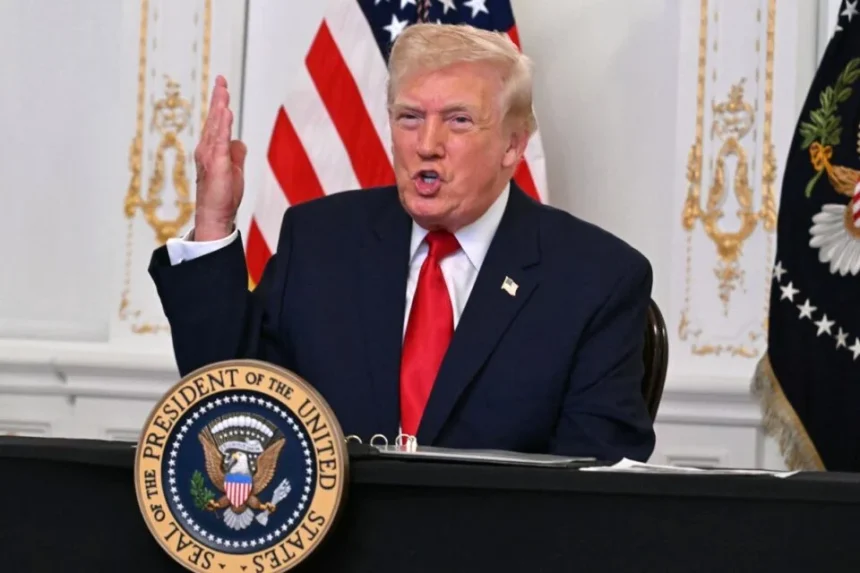
United States President Donald Trump has confirmed that American forces carried out multiple airstrikes on Islamic State (ISIS) fighters in Nigeria, describing the operation as decisive and warning that further military action would follow if attacks on civilians persist.
Trump disclosed the development late Thursday through a series of posts on his Truth Social platform, stating that the strikes were executed under his authority as Commander-in-Chief.
According to him, the operation targeted ISIS elements operating in Northwestern Nigeria, whom he accused of orchestrating sustained attacks on civilians, particularly Christians.
“At my direction, the United States launched a powerful and deadly strike against ISIS terrorists in Northwest Nigeria,” Trump wrote. “These terrorists have been viciously killing innocent people, and tonight, they paid the price.”
Pentagon Confirms Operation in Coordination With Nigeria
The strikes were later confirmed by U.S. Africa Command (AFRICOM), which stated that American forces conducted the operation on December 25, 2025, in Sokoto State, in coordination with Nigerian security authorities. AFRICOM said the strikes resulted in the deaths of multiple ISIS fighters, although it did not immediately release casualty figures.
“At the direction of the President and the Secretary of War, and in coordination with Nigerian authorities, U.S. Africa Command conducted strikes against ISIS terrorists in Nigeria,” the command said in a post on X.
U.S. Defence Secretary Pete Hegseth also acknowledged the operation, describing it as a response to persistent attacks by extremist groups. He expressed appreciation for the cooperation of the Nigerian government, stressing that the operation reflected joint counterterrorism efforts.
“The President was clear: the killing of innocent civilians in Nigeria must end,” Hegseth said. “The Department of War is always ready, and ISIS found that out.”
Strike Follows Deadly Maiduguri Mosque Bombing
The U.S. airstrikes came barely 24 hours after a deadly explosion ripped through a mosque in Maiduguri, Borno State, killing at least five worshippers and injuring dozens. Nigerian authorities suspect the incident was a suicide bombing linked to extremist groups operating in the region.
Security analysts say the timing of the U.S. operation suggests a broader response to escalating militant violence across Nigeria, particularly in the North-East and North-West regions where Boko Haram and the Islamic State West Africa Province (ISWAP) remain active.
Trump Issues Fresh Warning
Trump used the announcement to issue a stern warning to militant groups operating in Nigeria, stating that the United States would not hesitate to carry out additional strikes if attacks continue. He emphasized that under his leadership, Washington would not allow extremist groups to gain a foothold or threaten civilian populations.
“If the slaughter continues, there will be many more strikes,” Trump said, adding that U.S. military capability remains unmatched.
The former president has previously criticized Nigeria’s handling of insecurity. In November, he warned that the U.S. could cut off aid and take direct military action if Nigerian authorities failed to stem the violence against civilians.
Nigeria’s Security Challenges Under Global Spotlight
Nigeria has faced prolonged security challenges from multiple armed groups, including Boko Haram, ISWAP, bandits, and other extremist factions. These groups have carried out mass kidnappings, bombings, and coordinated attacks on both civilian and military targets.
While Nigerian authorities have not disputed the U.S. operation, officials continue to emphasize intelligence-sharing and regional cooperation as key strategies in combating terrorism.
Security experts say the latest airstrikes highlight growing international concern over the spread of extremist violence in West Africa, as well as the increasing willingness of foreign powers to intervene directly.