


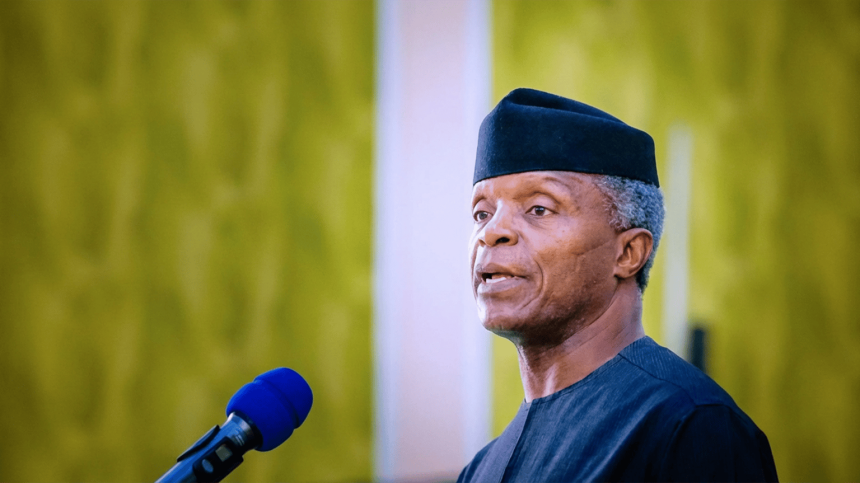
Former Vice President Yemi Osinbajo (SAN) has called on governments at all levels to prioritise infrastructure development as the foundation for sustainable and inclusive housing delivery in Nigeria.
Osinbajo said the country’s persistent housing crisis is not due to a lack of workable models but rather weak political will and institutional failure to replicate proven approaches.
He made the call at the 2026 WEMABOD Limited Real Estate Outlook, themed “Unlocking Land and Infrastructure for Inclusive Housing: A Regional Agenda for Sustainable Urban Growth.”
Drawing lessons from the historic Bodija Estate in Ibadan, Osinbajo said Nigeria once demonstrated a successful housing model built on proper planning and early infrastructure provision, but failed to sustain and scale it across regions.
According to him, Bodija was designed as a complete neighbourhood rather than a mere housing cluster, with demand anticipated and planned as part of a wider development strategy.
“Demand was anticipated. It was planned for and shaped, not reacted to after the fact,” Osinbajo said.
He explained that the estate followed clear planning standards, featuring low-rise density, green buffers and open spaces, while prioritising privacy, social integration and livability.
Osinbajo noted that Bodija’s proximity to employment centres, public institutions and essential services reduced commuting time and ensured strong integration into the city’s economic and social life.
He added that the estate deliberately accommodated different income groups within the same community, with modest bungalows for low-income earners, semi-detached houses for middle-income residents and larger homes for senior professionals.
According to him, one of Bodija’s most critical strengths was the delivery of infrastructure before residents moved in. Roads, drainage systems, water supply, electricity, schools and community facilities were provided upfront, significantly reducing living costs.
Osinbajo described infrastructure as a hidden subsidy that made housing affordable by removing the burden of self-provision from households.
He said the failure of the Bodija model was not in its design, but in the inability of governments to replicate it across the South-West and other parts of the country.
Contrasting past approaches with current trends, Osinbajo observed that many modern housing estates are gated, homogeneous and driven largely by short-term commercial interests.
He noted that most new developments are located on city fringes, far from employment centres and public transport, leading to longer commute times, higher transportation costs, reduced productivity and increased carbon emissions.
He added that infrastructure in many estates has effectively been privatised, with residents forced to provide their own water, power, access roads and waste management, driving up housing costs and excluding low- and middle-income earners.
Osinbajo rejected claims that governments lack the capacity to deliver mass housing, insisting the challenge lies in misplaced priorities.
He cited examples from his tenure as Vice President, noting that Borno State delivered nearly 15,000 housing units within three and a half years despite limited internally generated revenue.
The former Vice President identified land and infrastructure as the two major constraints to inclusive housing in Nigeria.
He called for government-led land assembly, early provision of bulk infrastructure and mandatory inclusionary zoning in large housing developments.
Osinbajo also advocated properly structured public-private partnerships, where governments provide land, infrastructure and clear regulatory frameworks, while private developers contribute capital, technical expertise and execution capacity.
He said such collaboration remains key to closing Nigeria’s housing gap and achieving sustainable urban growth.
