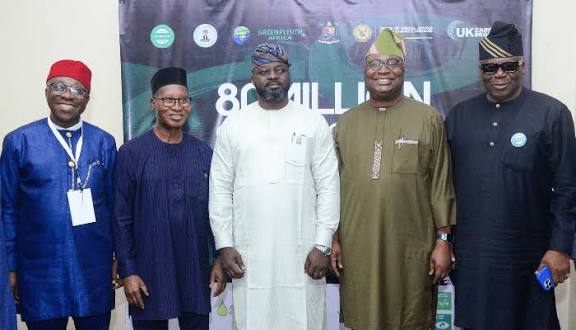
The Federal Government is expected to generate as much as $5 billion annually from carbon credit revenues through the implementation of the 80 Million Clean Cookstoves Project.
The projection was disclosed by the Group Chief Financial Officer of GreenPlinth Africa Limited, Babatunde Aina, during a media engagement ahead of the Green Conference and 2026 Projects Implementation Retreat scheduled to hold in Lagos from March 3 to 5.
Aina described the initiative as one of the most ambitious climate, economic and social intervention programmes ever undertaken in Africa, noting that it positions Nigeria strategically within the global carbon market.
According to him, the clean cookstoves project goes beyond improving cooking methods, as it is designed to drive environmental sustainability while unlocking long-term economic value through verified carbon credits.
“When fully deployed, the 80 million clean cookstoves project will enable the Federal Government of Nigeria to earn up to $5 billion annually from verified carbon credit revenues,” Aina said.
He explained that the benefits would not be limited to the federal level, as states, local governments, host communities and participating households would also gain through transparent carbon revenue-sharing mechanisms.
Aina added that the project aims to transform the daily cooking experience of over 80 million Nigerians, particularly women and children, by providing modern and efficient clean-cooking solutions at no cost to households.
Each beneficiary household, he said, would receive a thermally optimised clean cookstove with two 15-litre cooking pots, equipped with digital metering and GPS tracking to monitor cooking activity and carbon emissions avoided in real time.
He noted that the stoves require significant heating only once, retain heat for up to five hours and can operate on a single briquette for extended cooking periods, improving efficiency and reducing fuel use.
Explaining the carbon market structure, Aina said the project is designed to operate within the compliance carbon market, which is regulated and offers higher value compared to the voluntary market.
“The compliance market is currently valued at about $104 per metric tonne, ensuring sustainability and long-term economic impact,” he said, describing carbon as a new global currency.
He disclosed that full-scale implementation would begin in Lagos, Niger, Enugu, Nasarawa, Benue, Kebbi, Borno and Delta states, with plans for structured nationwide expansion.
Former Deputy Governor of the Central Bank of Nigeria, Tunde Lemo, described the initiative as a major shift in Nigeria’s environmental consciousness and a landmark climate and public health intervention.
Lemo said the project could remove an estimated 1.2 billion metric tonnes of carbon dioxide annually when fully implemented, making it the largest household energy transition initiative globally.
He added that the programme is registered on the United Nations Framework Convention on Climate Change Global Climate Action Portal, aligning Nigeria with international standards for climate transparency and accountability.
Lemo also noted that firewood sellers would be retrained and integrated into the clean energy value chain as briquette distributors, ensuring livelihoods are preserved while advancing the transition to cleaner energy.