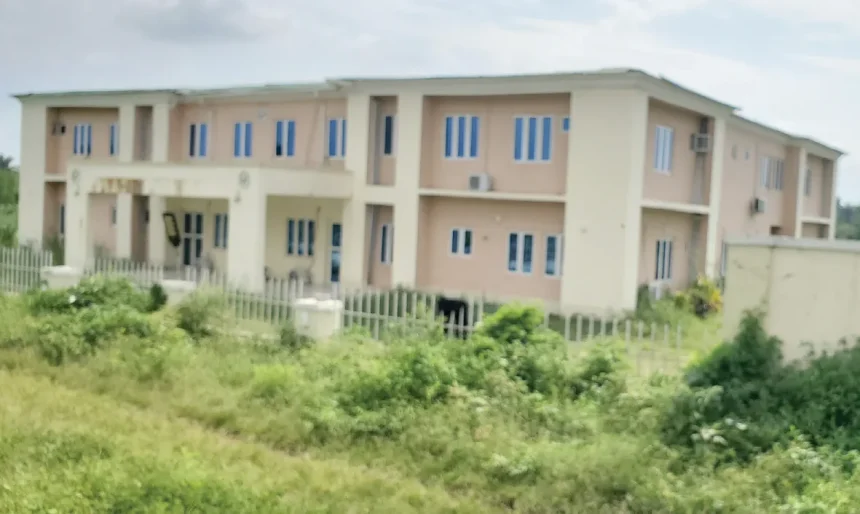
Rider: Residents of Ipetumodu say they are paying for security and maintenance while the new facility remains unused and the community’s ageing general hospital struggles with staff shortages and poor infrastructure.
An 80-bed hospital in Ipetumodu, Osun State, remains closed more than three years after its commissioning, leaving residents dependent on an ageing general hospital with inadequate facilities and limited medical personnel.
The modern facility was commissioned on May 23, 2023, and handed over to the Osun State Government for staffing, management and operation.
However, residents say it has yet to admit its first patient.
The hospital was developed through the Federal Government’s Sustainable Development Goals programme, with former presidential spokesman Femi Adesina facilitating the project.
Its continued closure has frustrated residents who expected the facility to improve access to healthcare in Ipetumodu and neighbouring communities.
The situation has also placed additional financial pressure on community leaders, who say they have been paying for security and maintenance to protect the unused building and its equipment.
The contrast is stark: a newly built hospital stands idle while the older General Hospital in Ipetumodu continues to deteriorate.
Community Pays To Protect Unused Hospital
Secretary of the Ipetumodu Development Forum, Kehinde Oyetunmbi, said residents had repeatedly appealed to the state government to make the facility operational.
He expressed concern that the government had yet to deploy the personnel needed to begin services despite receiving the completed project.
Oyetunmbi said the community had shouldered the cost of security for years, even though the facility was intended to serve the public.
The National Public Relations Officer of the Ipetumodu Development Union, Habeeb Arayemi, said the financial burden had become increasingly difficult to sustain.
According to Arayemi, the community had at one point struggled to find night guards willing to protect the premises.
He added that the late traditional interventions of community leaders included payments for security by the former Apetumodu of Ipetumodu, Oba Joseph Oloyede.
Residents say the government must assume responsibility for operating and maintaining the facility to prevent further deterioration.
Hospital Equipment Looted
The unused facility has also suffered security breaches.
Community representatives said thieves previously removed about 10 air conditioners and electrical cables during a single incident.
The theft prompted intervention through the office of the Deputy Speaker of the Osun State House of Assembly, who reportedly helped facilitate the replacement of some stolen equipment.
However, residents say the intervention did not lead to the hospital’s opening.
They also reported that a rainstorm damaged part of the roof, which the community subsequently repaired.
Arayemi said weeds had overgrown parts of the premises and that residents were still seeking resources to clear the vegetation.
The community fears that continued neglect could damage the building and equipment beyond economical recovery.
Residents have appealed to the state government to deploy medical personnel, complete any outstanding work and begin operations before the facility deteriorates further.
Patients Still Travel To Ile-Ife For Treatment
While the new hospital remains unused, residents say the old General Hospital cannot adequately meet local healthcare needs.
Vice Chairman of the Ipetumodu Development Forum, Banji Akinloye, said residents often travel to Ile-Ife for treatment because of limited services in their community.
He said private hospitals offer alternatives, but their costs place treatment beyond the reach of some households.
Akinloye warned that the distance could create serious difficulties for patients requiring urgent medical attention.
He argued that the community already has the infrastructure needed to improve healthcare access.
“The equipment is there; we just need personnel,” he said, appealing to the state government to take responsibility for making the new hospital functional.
The facility was designed to serve not only Ipetumodu but also surrounding settlements that depend on public healthcare services in the area.
Old General Hospital Falls Into Disrepair
The condition of the existing General Hospital adds to residents’ concerns.
During a visit on September 20, 2026, the facility appeared quiet, with no medical worker seen on the premises, according to the original report.
Community sources said staffing was severely limited, with only one nurse and one doctor reportedly available.
The nurse was said to work from Monday to Friday, while the doctor reportedly attended on Mondays and Thursdays.
The hospital, built in 1991, has suffered significant infrastructure deterioration.
Sections of its roof have been damaged, while parts of the building remain exposed.
The facility also relies on well water after its borehole stopped functioning.
The report described wards without beds or functioning medical equipment and said a small office had been converted into a makeshift ward.
Such conditions have raised concerns about the quality and availability of care for residents who cannot afford private treatment or travel to larger medical facilities.
Communities Beyond Ipetumodu Need The Hospital
The hospital’s importance extends beyond the immediate community.
Residents from Akinlalu, Asipa, Moro, Eduabon, Yakoyo, Isope, Ago-Owu and Araromi-Owu are among those reported to depend on healthcare services in the area.
Apomu, in Irewole Local Government Area, is also among the communities identified in the report.
For these settlements, the closure means that a facility designed to ease pressure on existing services remains unavailable.
The combination of limited staff, deteriorating infrastructure and inadequate equipment at the old hospital leaves residents with fewer accessible public healthcare options.
Community leaders have therefore called for the immediate deployment of doctors, nurses and other health workers to the new facility.
Arayemi also appealed to the Federal Government to consider affiliating the hospital with the Obafemi Awolowo University Teaching Hospitals Complex in Ile-Ife.
He said such an arrangement could provide a pathway towards effective management and operation.
Contractor Cites Funding Constraints
The original report said the contractor responsible for the project was yet to complete some outstanding work required to make the facility operational.
The contractor reportedly attributed the delay to the exhaustion of funds released for the project.
The report did not establish the precise amount required to complete the remaining work or provide a timeline for its completion.
The community has continued to appeal for government intervention, arguing that the existing building and equipment should not remain unused while residents struggle to access medical care.
Osun Government Yet To Respond
Community leaders said they had made several efforts to draw the state government’s attention to the hospital’s condition.
They praised the Deputy Speaker of the Osun State House of Assembly, Akinwunmi Ireyode, for reportedly visiting the facility and raising concerns about its future.
However, they said the lawmaker could not independently provide the staffing and administrative arrangements required to open the hospital.
Efforts to obtain a response from the Osun State Commissioner for Health, Jola Akintola, were unsuccessful at the time the original report was filed.
Calls went unanswered, while messages seeking clarification on the government’s plans had not received a response.
The state government’s position on the reasons for the prolonged closure therefore remains unclear.
A Healthcare Investment Waiting To Deliver
The situation in Ipetumodu highlights the gap that can emerge between completing public infrastructure and delivering the services it was built to provide.
A hospital’s value depends not only on its building and equipment but also on staffing, maintenance, funding, reliable utilities and effective management.
For residents, opening the 80-bed facility could reduce pressure on the old general hospital and improve access to treatment across neighbouring communities.
The immediate challenge is to establish what remains outstanding, provide the necessary personnel and resources, and ensure the facility can operate safely.
Until those steps are taken, the new hospital will remain an unused public asset while residents continue seeking treatment elsewhere.
For Ipetumodu, the demand is straightforward: turn the completed investment into a functioning healthcare facility before further neglect undermines its purpose.