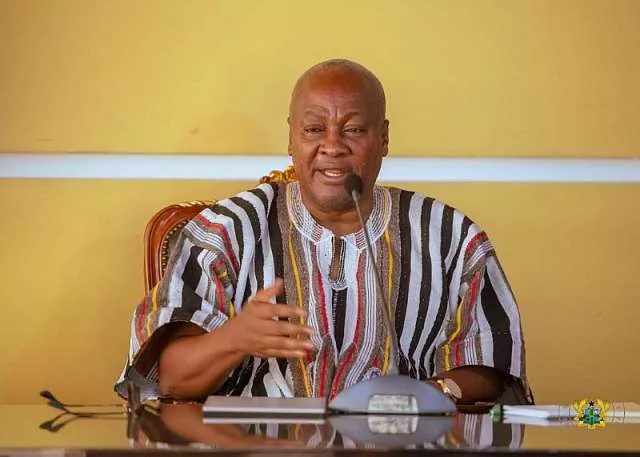
Ghana’s president says he hopes to replicate Kenya’s housing approach as his government plans a GH¢1 billion contribution to a proposed National Housing Fund in the 2027 budget.
Ghanaian President John Dramani Mahama has praised Kenyan President William Ruto’s affordable housing programme, saying Ghana could learn from Kenya’s approach as it seeks to address a housing deficit estimated at 1.8 million units.
Mahama made the remarks in Accra, where he highlighted the pace of housing construction in Kenya and expressed his ambition to expand access to affordable homes in Ghana.
The comments come as his administration prepares to strengthen housing finance through a proposed GH¢3 billion National Housing Fund, with the government planning to contribute GH¢1 billion through the 2027 budget.
According to Ghana’s Information Services Department, Mahama directed the finance minister to make the proposed allocation to support housing delivery and improve access to affordable financing.
Mahama Seeks Support to Expand Housing Delivery
Speaking at a public event in Accra, Mahama said the scale of construction in other countries had impressed him and reinforced his ambition to increase housing delivery in Ghana.
“Just came from Egypt and if you see the mountain that have been built there, it’s phenomenal. And my friend President Ruto is delivering houses at such a rate,” he said.
Mahama also recalled a conversation with Ruto in which the Kenyan leader called him “John the Baptist” in reference to his housing ambitions.
Responding, Mahama said he wanted to earn recognition as a home builder but acknowledged that the government could not achieve the goal without broader participation.
“I want to be called the home builder too, but I can’t do it alone. I need all of you in this room,” he said.
His appeal highlights the importance of collaboration among government agencies, financial institutions, property developers and other stakeholders in expanding housing supply.
Ghana Plans GH¢1 Billion Contribution to Housing Fund
Ghana’s proposed housing financing plan is a key part of the administration’s response to the country’s housing shortage.
On October 7, 2026, Mahama announced that he had directed the finance minister to allocate GH¢1 billion in the 2027 budget as the government’s contribution to a proposed GH¢3 billion revolving National Housing Fund.
The fund is intended to provide financing for housing projects and widen access to affordable homes. A revolving arrangement would allow funds to be deployed and returned for further financing, subject to the fund’s operating structure.
The government’s proposed contribution is not the same as a confirmed budget allocation for direct construction of a specified number of homes. The fund’s impact will depend on its final structure, additional sources of capital and the projects it finances.
Mahama has also called on pension funds, insurance companies, development finance institutions and diaspora investors to help mobilise long-term capital for housing.
The approach seeks to address not only the supply of homes but also the difficulty many households face in obtaining financing on affordable terms.
Kenya’s Housing Model Draws Regional Attention
Under Ruto, affordable housing has become a major component of Kenya’s development agenda, with the government presenting the programme as a means of increasing housing supply and creating employment in construction.
The initiative promotes access to homes through structured payment arrangements, with the stated aim of reaching households that struggle to purchase property through conventional market arrangements.
Mahama’s remarks suggest that Kenya’s experience is attracting interest as other African governments confront housing shortages, rising urban populations and limited access to affordable accommodation.
However, adopting elements of Kenya’s approach would require Ghana to assess its own land administration system, construction costs, financing arrangements and household incomes.
The availability of housing finance alone does not guarantee that homes will be affordable to lower-income households. Mortgage terms, repayment periods, infrastructure costs and the locations of new developments will also influence access.
Housing Delivery Remains the Central Test
Ghana’s estimated 1.8 million-unit housing deficit places pressure on the government to increase supply while ensuring that new developments meet the needs of households across different income groups.
The proposed National Housing Fund offers one route to mobilising capital, but its effectiveness will ultimately depend on how the money is deployed and whether the resulting homes are affordable to intended beneficiaries.
Mahama’s appeal for collective support also points to the role of private developers, financial institutions, employers and other partners in expanding housing delivery.
For Ghana, the next steps include translating the proposed funding commitment into an operational financing framework, securing additional investment and identifying projects capable of delivering homes at affordable prices.
While Mahama has expressed interest in learning from Kenya’s experience, the central measure of success will be whether Ghana can turn its housing ambitions into accessible homes for families facing the country’s accommodation shortage.