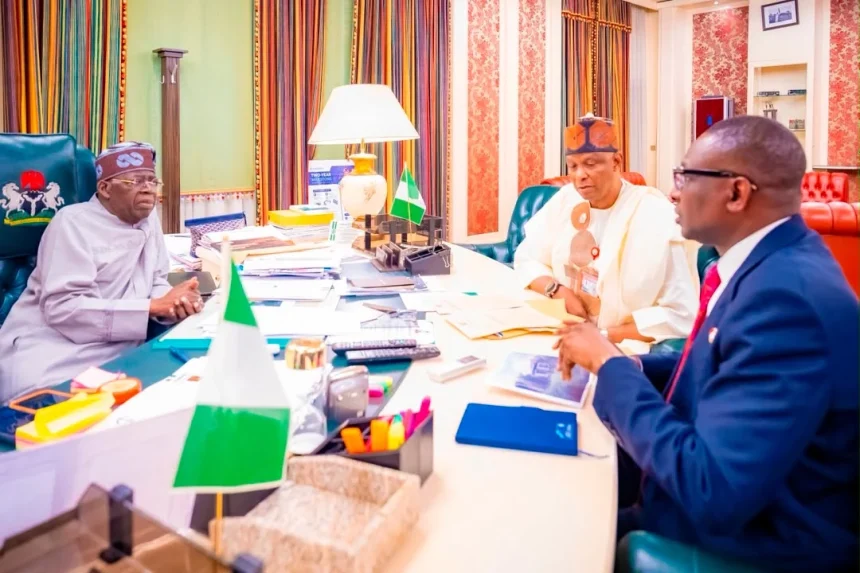
President Bola Ahmed Tinubu has received briefings from the Chairman of the Economic and Financial Crimes Commission (EFCC), Ola Olukoyede, and the Minister of Housing and Urban Development, Muttaqha Rabe Darma, on the management and disposal of houses seized by the anti-graft agency.
The meeting took place at the State House in Abuja on Tuesday, with the Presidency confirming that discussions focused on the handling of seized houses nationwide under principles of transparency and accountability.
The development places the management of recovered properties within a broader conversation about how assets recovered from corruption investigations should be handled once they come under government control.
FG Reviews Management of Seized Properties
The Presidency did not disclose details of the individual properties discussed or announce that any specific houses had been sold.
Instead, the meeting focused on the management and disposal of houses seized nationwide by the EFCC.
This distinction is important because recovered properties can remain under government control for a period before the necessary legal and administrative processes for disposal are completed.
The government has previously transferred recovered housing assets to the Ministry of Housing and Urban Development for management.
One notable example is a 753-unit housing estate in Abuja recovered from former Central Bank Governor Godwin Emefiele, which the EFCC handed over to the Housing Ministry in May 2025.
Transparency at the Centre of Disposal Process
The Presidency said the management and disposal process would be guided by transparency and accountability.
That is particularly important when dealing with properties recovered through financial-crime investigations because the assets represent public-interest recoveries.
A transparent disposal process would help establish how properties are valued, who can purchase them, how sales are conducted and how proceeds are accounted for.
It could also reduce concerns about recovered assets being transferred or sold below their market value.
Housing Assets Could Have Wider Impact
The involvement of the Housing Ministry also raises a broader question about how recovered residential properties can contribute to Nigeria’s housing needs.
Rather than viewing seized houses only as assets to be sold, government could potentially consider how some properties can support existing housing programmes, depending on their legal status and applicable government policy.
This could be particularly relevant in Abuja and other major cities where housing demand remains high and property prices continue to rise.
However, any decision to retain, convert, transfer or sell recovered properties would need to comply with the relevant legal and asset-disposal procedures.
Earlier Recovery of 753 Housing Units
The Federal Ministry of Housing and Urban Development previously took delivery of the 753-unit Abuja estate recovered by the EFCC from Emefiele. The handover was part of efforts to place recovered housing assets under the management of the housing authorities.
The estate provides an example of the potential scale of residential assets that can enter government control through asset-recovery processes.
Its eventual use or disposal therefore has implications beyond the recovery of proceeds from financial crimes.
The Bigger Housing Question
The latest meeting highlights an important issue for Nigeria’s housing sector: what should government do with residential properties recovered through corruption investigations?
Selling them could generate revenue for government, while retaining or integrating some properties into housing programmes could potentially expand the available housing stock.
Either approach requires clear valuation, transparent procedures and public accountability.
For the housing sector, the most important issue will be ensuring that recovered properties are not allowed to become another category of underutilised or abandoned government assets.
The Tinubu administration’s review therefore creates an opportunity to establish a clear framework for managing recovered housing assets, while ensuring that the public interest remains central to their eventual disposal or utilisation.