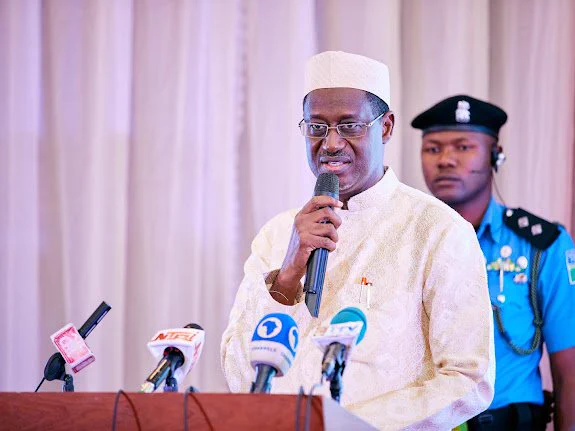
The Federal Government has disclosed that about 15.2 million housing units across Nigeria are structurally inadequate, raising fresh concerns about safety, habitability, and access to basic services nationwide.
The disclosure was made by the Minister of Housing and Urban Development, Arc. Ahmed Musa Dangiwa, in a statement released on Tuesday.
According to the minister, the affected homes physically exist but fail to meet minimum standards for safety, durability, decent living conditions, and access to essential infrastructure such as water, sanitation, and electricity.
Dangiwa explained that the findings were produced under the National Housing Data Initiative and presented by the National Housing Data Technical Committee in Abuja.
He noted that Nigeria’s housing challenge extends beyond the shortage of new homes and includes widespread structural inadequacy in existing buildings.
The assessment, he said, applied internationally recognised tools such as the Household Crowding Index, Adequate Housing Index, and Composite Index Methodology, using data from the National Population Commission (NPC), National Bureau of Statistics (NBS), Central Bank of Nigeria (CBN), and other housing institutions, in line with World Bank standards.
Dangiwa said the harmonised approach now allows the government to state with confidence the scale of housing inadequacy across the country.
He stressed that addressing the challenge will require more than constructing new houses, urging a focus on upgrading existing housing stock, regenerating deteriorating neighbourhoods, and improving infrastructure and public services.
The minister added that housing inadequacy is also linked to affordability gaps, limited access to land, weak housing finance systems, and significant regional disparities.
Data from the assessment showed that Kano State recorded the highest level of housing inadequacy, while Bayelsa State recorded the lowest, based on the Adequate Housing Index.
As part of efforts to address the problem, the Ministry of Housing and Urban Development has begun steps to establish a National Housing Data Centre, which will support policymaking, housing finance access, investment planning, and large-scale housing delivery.
The Data Centre is expected to improve planning accuracy, boost investor confidence, and strengthen accountability in the housing market. It is projected to become operational by mid-January 2026.
The minister noted that the Federal Government is currently implementing housing interventions under the Renewed Hope Estates and Cities Programme, with projects at various stages of completion nationwide.
Renewed Hope Cities are large-scale developments planned across the six geopolitical zones and the Federal Capital Territory, implemented through public-private partnerships.
Renewed Hope Estates, on the other hand, consist of smaller housing clusters of about 250 units, funded directly by the Federal Government, with state governments providing land and subsidised infrastructure to improve affordability.
Despite these initiatives, Dangiwa said Nigeria still faces a severe housing deficit, noting that closing the gap would require at least 550,000 new housing units annually, at an estimated cost of ₦5.5 trillion over the next decade.