


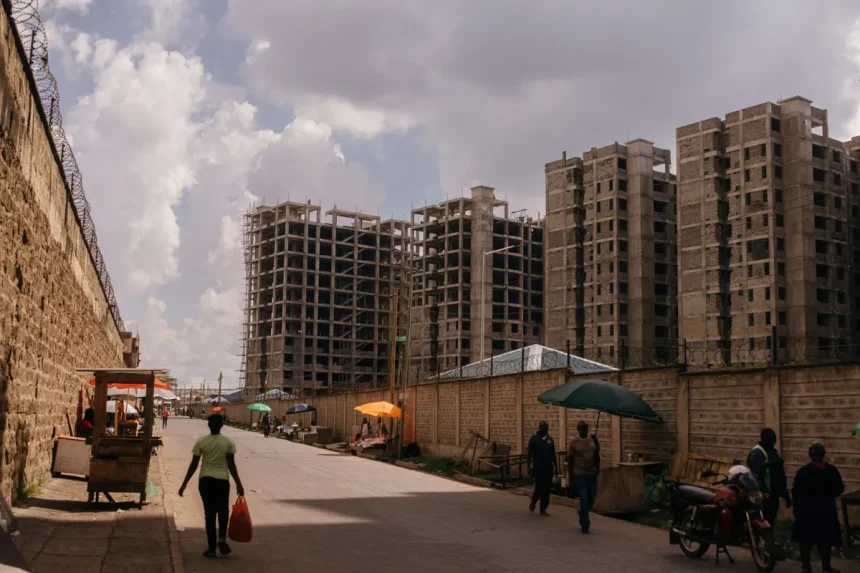
…….A KSh1.76 trillion affordable housing pipeline is facing financing challenges, with hundreds of projects reportedly stalled or progressing slowly.
Kenya’s ambitious affordable housing programme is facing a major funding squeeze that could delay projects and increase construction costs, according to recent government and parliamentary budget assessments.
President William Ruto’s administration has set an ambitious target of delivering about 200,000 affordable housing units annually as part of its broader housing and urban development agenda.
However, the scale of financing required to sustain the programme has emerged as a major challenge.
The affordable housing pipeline has an estimated value of about KSh1.76 trillion, equivalent to roughly $13.6 billion, while government budget and oversight reports indicate that implementation has fallen behind planned targets.
Recent assessments by Kenya’s Parliamentary Budget Office identified a financing gap of more than KSh118 billion and reported that 176 affordable housing projects had stalled.
Housing Programme Faces Financing Pressure
The funding challenge comes as Kenya attempts to expand affordable housing construction while operating under significant fiscal constraints.
The African Development Bank’s 2026 Kenya Country Focus Report said the country faces constrained fiscal space, elevated debt-service obligations and growing development financing needs.
The bank estimated Kenya’s annual development financing requirement at about $14.2 billion and projected a financing gap of approximately $12.5 billion by 2030.
It identified housing, infrastructure, climate resilience and job creation among the areas affected by the broader financing challenge.
The housing programme therefore faces competition for limited public resources at a time when the government is also dealing with debt-servicing obligations and other development priorities.
Billions Already Spent on Programme
Government expenditure data show that substantial resources have already been committed to the housing programme.
A recent report from Kenya’s Office of the Controller of Budget showed that cumulative expenditure on the affordable housing project had reached approximately KSh188.36 billion by June 30, 2026.
The total estimated value of the programme was put at about KSh1.758 trillion, with implementation expected to run through June 2032.
The figures show the difference between the resources already deployed and the much larger amount required to complete the overall pipeline.
The Controller of Budget’s assessment also highlighted implementation challenges.
During the 2025/26 financial year, only 1,836 housing units were completed and handed over, while another 1,380 units were described as substantially complete but awaiting handover.
At the same time, more than 103,000 units were under construction, while tens of thousands of additional units were at various stages including procurement, contract signing, site handover and preliminary works.
Annual Target Remains Ambitious
The government’s annual target of 200,000 units represents a substantial increase in housing construction capacity.
Kenya has identified affordable housing as one of the major pillars of its Bottom-Up Economic Transformation Agenda.
The programme is intended not only to provide lower-cost homes but also to stimulate construction activity, generate employment and support businesses involved in building materials, transport, manufacturing and related services.
The Kenyan Parliament has described the housing programme as a key component of efforts to reduce the country’s housing deficit and promote employment through construction.
However, official budget documents and implementation reports indicate that funding and project execution remain important constraints.
A 2025 Parliamentary Budget Office assessment had already noted that the affordable housing programme was not fully absorbing resources mobilised through the Affordable Housing Fund.
The assessment said some funds were either idle in the fund or invested in government securities, while only a fraction of units in the programme were scheduled for completion at that point.
Government Continues to Defend Programme
Despite concerns over financing and implementation, President Ruto has continued to defend the affordable housing programme.
During a September 14, 2026 engagement in Kisumu, Ruto said his administration had deployed KSh44 billion toward the construction of 12,000 housing units, 20 markets and 12,000 hostel beds in the city.
He also said the wider programme had created employment opportunities for about 1.1 million people.
Ruto argued that stopping the programme would affect both housing delivery and employment in the construction sector.
The government has also continued to allocate significant funds to housing in its annual budgets.
For the 2026/27 financial year, Kenya’s National Assembly approved KSh138.2 billion for the housing sector, including KSh50 billion specifically for the Affordable Housing Programme.
Parliament said the allocation was intended to accelerate housing delivery while creating employment opportunities for young people across the construction value chain.
Financing Model Under Pressure
Kenya’s housing programme relies on a combination of public funding, the Affordable Housing Fund, private-sector participation and other financing mechanisms.
The government has sought to expand the Housing Fund and increase access to mortgage financing as part of its broader housing strategy.
Its 2026 Budget Policy Statement said the government planned to scale up the Housing Fund, expand the Boma Yangu affordable mortgage product and partner with financial institutions to provide long-term, lower-cost mortgages.
The government also planned to provide KSh1 billion in rural housing loans to underserved communities.
The financing structure means that continued progress depends not only on government budget allocations but also on the ability to mobilise private capital and ensure that available funds are released and deployed efficiently.
Project Delays Could Increase Costs
Delays in construction can create additional financial pressure because projects that remain unfinished may require higher funding as construction costs rise.
The Parliamentary Budget Office has warned more broadly that delayed fund releases, weak coordination, unresolved policy and legal issues, inadequate monitoring and growing outstanding obligations can undermine the implementation of government programmes.
For affordable housing, prolonged delays could therefore widen the gap between the programme’s original financial estimates and the eventual cost of completing projects.
The challenge is particularly significant given the size of the pipeline and the government’s annual construction target.
Housing Demand Remains High
The funding problems come against the backdrop of substantial demand for affordable housing in Kenya.
The government has positioned the programme as a response to the shortage of decent and reasonably priced housing, particularly for low- and middle-income households.
Beyond homeownership, the programme is also linked to urban renewal, informal settlement upgrading and the development of supporting infrastructure.
The government’s housing strategy therefore extends beyond individual housing units to include markets, hostels, urban infrastructure and other facilities.
Kenya’s 2026/27 budget also allocated resources to informal settlement improvement and other housing-related programmes.
Funding Will Determine Next Phase
The latest figures underline the scale of the challenge facing Kenya’s affordable housing programme.
With a pipeline estimated at about KSh1.76 trillion and a reported financing gap exceeding KSh118 billion, securing sustainable funding will be central to completing stalled projects and maintaining construction momentum.
Government officials continue to defend the programme’s economic and social objectives, while parliamentary and budget oversight reports have highlighted financing and implementation weaknesses.
The immediate challenge is therefore not simply the number of homes planned but the government’s ability to mobilise, release and effectively deploy the capital required to complete them.
As Kenya moves deeper into the implementation of its housing agenda, the availability of financing and the pace of project execution will remain key indicators of whether the programme can meet its stated targets.