


Lagos Governorship Candidates Outline Competing Housing and Job Creation Plans Ahead of 2027 Election
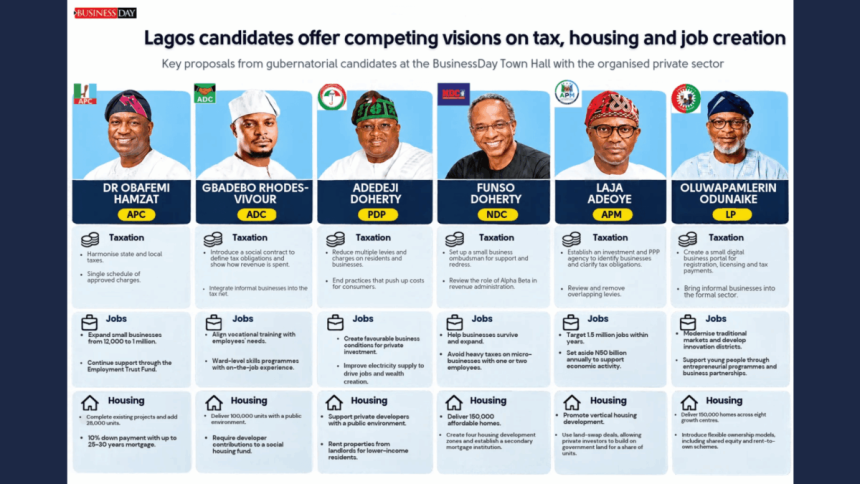
Lagos governorship candidates have presented competing proposals to address the state’s housing deficit, unemployment and rising cost of living, with affordable housing and private-sector investment emerging as major issues at a BusinessDay Town Hall meeting.
The candidates outlined different approaches to expanding housing supply, improving access to mortgage financing and creating employment opportunities during the engagement with organised private-sector stakeholders.
The proposals come ahead of the February 6, 2027 governorship election, with candidates identifying high construction costs, limited access to finance, expensive land and infrastructure deficits as major challenges affecting housing delivery in Lagos.
Candidates propose different affordable housing targets
Funso Doherty of the Nigeria Democratic Congress (NDC) proposed delivering 150,000 affordable housing units over four years, targeting low- and middle-income earners.
His proposal includes establishing four priority housing development zones and making government land available to private developers to increase housing supply.
He also proposed creating a secondary mortgage institution to provide additional liquidity to primary mortgage providers, enabling more Nigerians to access housing loans.
Oluwapamilerin Odunaike of the Labour Party proposed constructing 100,000 affordable homes across eight growth centres in Lagos.
He advocated flexible homeownership arrangements, including shared equity, rent-to-own schemes, cooperative financing and employer-supported housing.
Odunaike also linked housing development to employment generation, noting that the construction of 100,000 homes could create jobs across the building and construction value chain.
Gbadebo Rhodes-Vivour of the African Democratic Congress (ADC) also proposed delivering 100,000 housing units within four years.
His approach includes modular construction to reduce building costs and accelerate project delivery, alongside partnerships with private developers and streamlined approval processes.
He further proposed establishing a social housing fund, with developers contributing either financial resources or completed housing units.
Hamzat proposes 28,000 additional housing units
Obafemi Hamzat of the All Progressives Congress (APC) outlined plans to complete existing housing projects and deliver an additional 28,000 units through partnerships with private developers.
He highlighted the importance of mortgage financing in improving access to homeownership, proposing arrangements that would allow eligible buyers to make a 10 per cent initial payment and spread repayments over 25 to 30 years, depending on their age.
Hamzat also said the digitisation of land administration and building approval processes had reduced processing time to 19 days, a development he argued would help lower costs for property developers.
Laja Adeoye of the Allied Peoples Movement (APM) advocated vertical housing development and land-swap arrangements to maximise the use of available land in Lagos.
Under the proposed arrangement, private investors would develop government-owned land in exchange for an agreed share of completed properties.
He argued that the state’s limited land availability makes more efficient land use necessary to expand housing supply.
Adedeji Doherty of the Peoples Democratic Party (PDP) proposed government support for private developers through an improved business environment and mortgage guarantees.
He also suggested that the government could rent properties from private landlords and make them available to lower-income residents who cannot afford homeownership.
Employment and construction emerge as connected priorities
Beyond housing, the candidates presented different strategies for expanding employment opportunities through small businesses, skills development, entrepreneurship and infrastructure investment.
Adeoye proposed targeting 1.5 million jobs over four years, supported by small businesses, entrepreneurship and skills development. He also proposed allocating N50 billion annually to support economic activities.
Odunaike identified market modernisation, innovation districts and entrepreneurship programmes as part of his employment strategy.
Rhodes-Vivour proposed aligning vocational training with employers’ skills requirements and establishing ward-level skills acquisition programmes that would allow participants to earn while learning.
He also linked the proposed 100,000 housing units to employment opportunities through construction-related activities.
Hamzat emphasised private-sector-led job creation and proposed increasing the number of small businesses in Lagos from approximately 120,000 to one million.
He also highlighted the Lagos State Employment Trust Fund’s role in providing businesses with advisory services, mentoring and access to capital.
Candidates address multiple taxation and business challenges
The town hall also featured discussions on taxation, with candidates proposing different approaches to reducing the burden of multiple levies on businesses.
Odunaike proposed a single digital business portal to harmonise government services, licensing and regulatory processes.
Adeoye advocated reviewing overlapping charges and establishing an investment and public-private partnership agency.
Rhodes-Vivour proposed a social contract that would clearly communicate taxpayers’ obligations and demonstrate how government revenue is spent.
Hamzat said his administration would work with local governments to harmonise tax collections, publish approved charges and establish a complaints centre to address reported cases within 48 hours.
The discussions highlighted the connection between business conditions, employment generation and housing affordability, with candidates presenting different approaches to using public resources and private investment to address Lagos’ development challenges.
The February 6, 2027 governorship election will determine which administration takes responsibility for implementing the competing proposals over the next four years.