


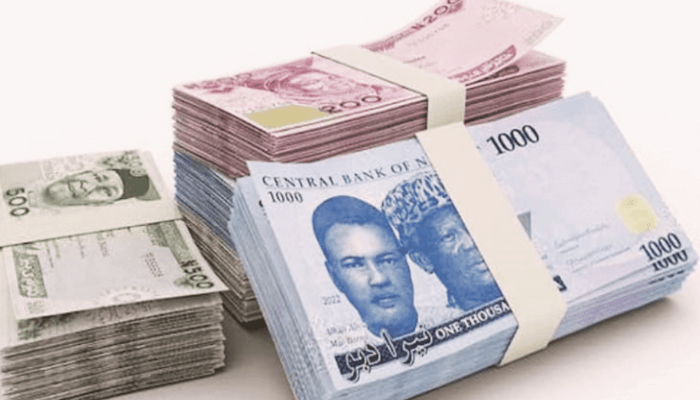
The spread between Nigeria’s official foreign exchange market and the parallel market narrowed further to N65 on Friday as Bureau De Change (BDC) operators prepared to access fresh dollar supply from banks following the Central Bank of Nigeria’s (CBN) decision to reopen the retail FX window.
The gap contracted from N92 on Wednesday to N65 by Friday, representing a 4.6 percent reduction and signalling renewed convergence between both segments of the market.
Official Market Performance
Data from the CBN showed the naira depreciated marginally for the second time during the week, weakening by N1.76 to close at N1,355.42 per dollar on Friday, compared to N1,353.66 on Thursday at the Nigerian Foreign Exchange Market (NFEM).
However, on a week-on-week basis, the currency recorded a gain of N10.77, strengthening from N1,366.19 per dollar a week earlier to N1,355.42.
Across the five trading sessions, the naira appreciated slightly by N1.16 from Monday’s opening rate of N1,354.26.
Parallel Market Gains
In the parallel market, the naira appreciated by N10 to trade at N1,420 per dollar on Friday, compared to N1,430 on Thursday, representing a 0.7 percent gain.
The narrowing spread comes ahead of actual dollar allocations to BDCs, suggesting that policy signalling alone influenced market expectations and dampened speculative positioning.
January Momentum and Reserve Growth
According to the Financial Market Dealers Association (FMDA), the naira appreciated by an average of 2.47 percent in January 2026, trading within the N1,300 per dollar range — its strongest level since the second quarter of 2024.
Analysts attributed the performance to firmer crude oil prices, which rose above $70 per barrel toward the end of January, and a softer U.S. dollar during the same period.
Nigeria’s external reserves also sustained steady growth, rising to $47.53 billion as of February 10, 2026, strengthening the CBN’s capacity to support exchange rate stability.
BDC Market Re-entry
Aminu Gwadabe, President of the Association of Bureaux De Change Operators of Nigeria (ABCON), said the narrowing spread reflects confidence in the CBN’s forward communication strategy.
He noted that BDC operators have begun engaging their banks to understand operational modalities for accessing foreign exchange under the new framework, with full operational rollout expected before the end of the week.
In a circular dated February 10, the CBN authorised duly licensed BDCs to purchase foreign exchange from the NFEM through authorised dealer banks at prevailing market rates.
The development follows the apex bank’s confirmation in September 2025 that 82 BDC operators were fully licensed under the revised regulatory framework, with operations commencing in late November as part of reforms to formalise retail FX supply.
Under the new structure, authorised dealer banks must conduct full know-your-customer (KYC) checks and due diligence in line with anti-money laundering and counter-terrorism financing regulations. BDCs may access up to $150,000 weekly strictly for eligible retail transactions.
Market Outlook
Market analysts say the re-entry of BDCs into the official FX supply chain is expected to improve liquidity at the retail end, reduce the premium between official and parallel markets, and enhance price discovery.
The policy shift is also anticipated to curb speculative activity, improve transparency, and reinforce investor confidence in Nigeria’s foreign exchange market as authorities pursue exchange rate convergence.
With reserves climbing and supply channels reopening, attention now turns to whether sustained inflows and disciplined implementation will further compress the spread in the coming weeks.