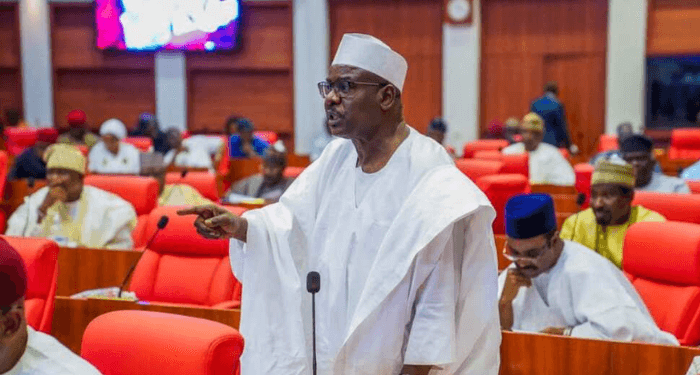
Senator Mohammed Ali Ndume, representing Borno South, has asked the North East Development Commission (NEDC) to build more houses in communities affected by insurgency and displacement.
Ndume made the request during a courtesy visit to the NEDC Managing Director and Chief Executive Officer, Mohammed Goni Alkali.
He also called for the creation of an NEDC annex office in Biu. According to him, the office would make it easier for people in Southern Borno to access the commission’s programmes.
The senator said a local office would bring NEDC services closer to residents. It could also reduce the need for people to travel long distances to access the commission.
Housing needed for displaced families
Ndume placed particular emphasis on housing. He identified Damboa, Chibok, Gwoza, Askira-Uba and Biu as areas that need more housing projects.
He said additional homes would support displaced families. They would also help communities affected by insurgency with their resettlement and recovery efforts.
Housing is an important part of rebuilding communities affected by conflict. Families returning to these areas need safe homes as well as roads, schools, healthcare and other basic services.
More housing construction could also support local economic activity. Building projects create demand for construction workers, materials and other services.
Senator seeks support for education and roads
Ndume also asked the NEDC to provide more infrastructure support to key educational institutions in Borno South.
He mentioned the Federal College of Education, Gwoza, and the Nigerian Army University, Biu.
The senator also urged the commission to help complete the Izge–Bita Road. He said he facilitated the project last year, but funding problems have slowed its progress.
Improved road links are important to housing and community development. Roads can improve access to homes, schools, health facilities, markets and other public services.
Ndume commends NEDC’s UMTH investment
The senator also praised the NEDC for its investment in the University of Maiduguri Teaching Hospital (UMTH).
He highlighted the commission’s support for the hospital’s fertility centre. The facility provides specialised reproductive and fertility-related medical services.
Ndume’s comments reflect the wider need to connect housing development with healthcare, education and transport infrastructure.
NEDC responds to Biu office request
Alkali thanked Ndume for the visit and his continued interest in the development of the North-East.
He said the NEDC remains focused on improving living conditions across the region through development projects.
On the proposed Biu office, Alkali explained that the NEDC Act provides for offices across the six states of the North-East.
He said the commission already has offices in some states. Other offices, he added, are at different stages of construction.
Alkali explained that NEDC offices are mainly established at the state level. However, he said the commission would continue to look for ways to bring its services closer to communities.
NEDC promises continued housing investment
Alkali also responded to the request for more housing in Borno South.
He assured Ndume that the commission would continue to invest in quality housing. He said particular attention would be given to communities recovering from insurgency and displacement.
The response keeps housing at the centre of the wider reconstruction effort in the North-East. For displaced families, the availability of homes can play an important role in supporting their return and resettlement.
The requests from Ndume also show the need for housing projects to be supported by roads, education, healthcare and other infrastructure.
For communities rebuilding after years of insecurity, these services are important to creating conditions where families can return, settle and rebuild their lives.
The proposed expansion of housing and infrastructure in Borno South therefore goes beyond the construction of individual homes. It highlights the role of coordinated public investment in supporting resettlement and the recovery of communities affected by displacement.