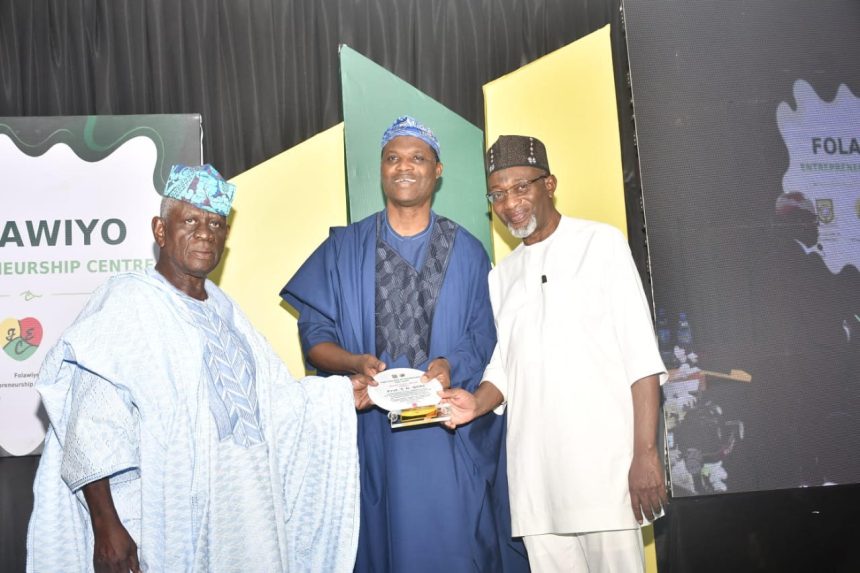
UNILAG Professor Timothy Nubi urges urban regeneration, improved infrastructure and stronger housing policies.
A Professor of Estate Management and Valuation at the University of Lagos, Timothy Nubi, has urged the Nigerian government to shift its housing policy from constructing buildings to developing sustainable, inclusive and resilient communities.
Nubi made the call during the second lecture series of the Folawiyo Entrepreneurship Centre (FEC), Yaba College of Technology, held on Wednesday.
The lecture was themed, “Sustainable Estate Development in Nigeria: Building Resilient Communities Through Clean Water, Clean Energy and Innovation.”
The don said housing delivery should not be measured solely by the number of houses constructed or settlements cleared. Instead, he said, the focus should be on affordability, functionality, inclusion, environmental responsibility and long-term resilience.
According to Nubi, Nigeria’s housing crisis extends beyond inadequate housing units to issues involving affordability, infrastructure, environmental risks, quality and institutional capacity.
“Sustainable estate development should integrate land, buildings, infrastructure, institutions and human communities to create long-term social, economic and environmental value,” he said.
Nubi Advocates Urban Regeneration
Nubi called for urban regeneration and in-situ upgrading to become central components of Nigeria’s housing strategy, particularly in underserved communities that can be improved and made safer.
He advocated development-led urban management, which would combine land-use planning, infrastructure development, environmental management, housing rehabilitation, tenure security, local economic development and community participation.
He said in-situ upgrading should be prioritised where settlements could be made safe and resilient.
Such interventions, he explained, should include improved roads and drainage systems, clean water, sanitation, electricity, waste management, public spaces, social facilities and housing rehabilitation.
Nubi also recommended phased implementation to allow residents to remain in their communities whenever possible.
He warned that temporary relocation, where unavoidable, should include clear information, fair compensation, secure return rights or suitable nearby accommodation, as well as protection for residents’ livelihoods.
Professor Warns Against Forced Displacement
The university lecturer cautioned that urban regeneration could lead to unintended consequences, including land speculation, rising rents, forced displacement and the replacement of low-income residents by wealthier groups.
To address these risks, he recommended tenure regularisation, affordability safeguards, community land arrangements, transparent valuation and inclusive financing.
Nubi also rejected the perception that sustainability only increases real estate development costs. He argued that its benefits should be evaluated through lifecycle costs.
He said responsible infrastructure and environmentally sustainable systems could reduce expenses linked to energy consumption, water supply, infrastructure failure, flood damage, maintenance and environmental degradation.
He added that sustainable estate development could improve reliability, strengthen resilience, reduce operating costs and preserve long-term property value.
Nubi urged government agencies, developers, financial institutions, professional bodies, communities, technology providers and educational institutions to work together.
He said government should provide effective spatial planning, efficient development approvals, infrastructure coordination, environmental regulation, building standards and supportive financial frameworks.
According to him, the private sector should contribute investment, innovation and infrastructure development.
YABATECH Management Highlights Entrepreneurship
Earlier, the Rector of Yaba College of Technology, Dr Ibraheem Abdul, urged students and staff to use entrepreneurship, innovation and practical knowledge to address Nigeria’s environmental and developmental challenges.
Abdul said the lecture series was designed to expand the institution’s entrepreneurial activities and expose members of the college community to practical enterprise opportunities.
He noted that the Folawiyo Entrepreneurship Centre was established through the support of Chief Tunde Fanimokun in honour of his benefactor, Chief Iyanda Olayinka Folawiyo.
The rector said Folawiyo’s entrepreneurial legacy across trading, oil and gas, energy, shipping, agriculture and real estate informed the centre’s activities.
He also described the programme’s focus on clean water, clean energy and sustainable communities as consistent with the United Nations Sustainable Development Goals 6, 7 and 11.
The Chairman of the Folawiyo Entrepreneurship Centre, Chief Tunde Fanimokun, encouraged students to embrace entrepreneurship as a pathway to sustainability, personal development and wealth creation.
He urged students to take advantage of the centre’s opportunities, mentorship and practical knowledge.
Fanimokun identified real estate as a major avenue for wealth creation and advised students to pursue activities aligned with their interests.
The Director of the Entrepreneurship Centre, Dr Funmilayo Adeoye, challenged students to transform innovative ideas into sustainable businesses capable of addressing real-world challenges.
She said the centre would provide opportunities for funding, mentorship, expertise and industry partnerships to help promising ideas develop into viable enterprises.
The programme also featured awards for staff and students who emerged winners in the centre’s business idea pitchathon.