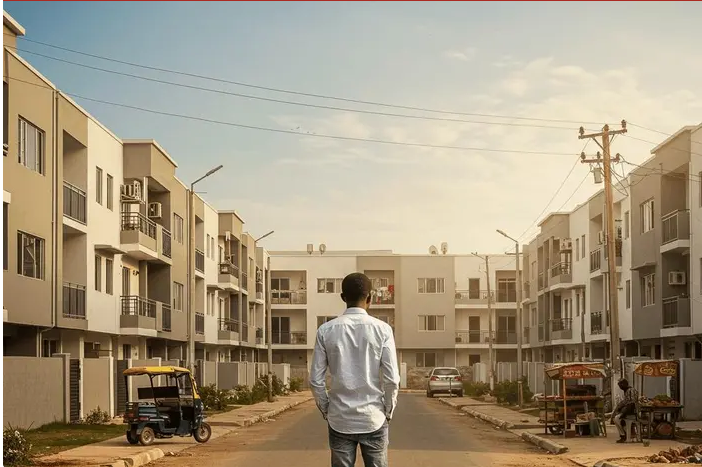
The dream of building a personal home is becoming increasingly difficult for young Nigerians as rising construction costs, expensive land, limited mortgage access and declining purchasing power combine to weaken housing affordability.
For many young people, securing employment and maintaining regular savings no longer provide a reliable path to homeownership. A growing proportion of household income is now spent on food, rent, transportation, electricity and other necessities, leaving little for land acquisition or construction.
A 2024 savings report by PiggyVest indicated that 65 per cent of Nigerians surveyed either earned below ₦100,000 monthly or had no income.
Only 57 per cent reportedly had some form of financial safety net, down from 64 per cent in the preceding year. The report also found that just 15 per cent had increased their savings, while 19 per cent of those who previously maintained emergency funds had lost them.
The income challenge has been compounded by sharp increases in the prices of essential building materials.
A March 2026 market report placed the price of a 50-kilogramme bag of cement at between ₦11,500 and ₦15,000, compared with about ₦2,500 to ₦3,000 in 2019.
This represents an increase of as much as 367 per cent within seven years.
For a residential project requiring hundreds of bags of cement, the price difference can add several millions of naira to the construction budget.
Other building inputs, including reinforcement steel, sand, granite, roofing sheets, tiles, electrical materials and plumbing products, have also recorded substantial price increases.
Some major building materials reportedly rose by more than 60 per cent, with the increase attributed to inflation, exchange-rate instability, transportation expenses, taxes and higher production costs.
These price changes create severe difficulties for individuals constructing their homes in phases. A budget prepared at the foundation stage may no longer be realistic by the time the owner is ready to begin roofing or finishing work.
Land acquisition presents another major obstacle. In Lagos, Abuja and other rapidly growing urban centres, the cost of land can consume a substantial portion of a young worker’s lifetime savings before construction even begins.
Prospective homeowners must also pay for surveys, title documentation, planning approvals, architectural drawings and other preliminary requirements.
Borrowing is equally difficult. Commercial interest rates remain too high for many individuals seeking loans to build or purchase residential properties.
Although mortgage products are available, eligibility conditions, equity contributions, property-documentation requirements and repayment obligations can exclude workers with modest or irregular incomes.
Labour and professional services add another layer of expense. Residential construction requires masons, carpenters, plumbers, electricians, roofers, painters and tilers.
Developers and individual builders must also engage qualified architects, engineers and quantity surveyors to ensure that projects comply with planning requirements and safety standards.
Attempts to reduce costs by avoiding competent professionals can expose homeowners to defective construction, project abandonment, building failure and future legal problems.
The seven major pressures affecting young prospective homeowners are declining disposable income, expensive cement, rising prices of other materials, high land costs, costly credit, increased labour and professional fees, and inflation during construction delays.
The situation underscores the need for housing policies that recognise the income realities of Nigeria’s young population.
Government interventions could include serviced land schemes, single-digit mortgages, rent-to-own programmes, housing cooperatives, affordable building-material initiatives and support for professionally managed incremental construction.
Reducing the cost of homeownership will require more than encouraging young Nigerians to save. It demands coordinated reforms covering land, finance, infrastructure, construction materials, wages and property documentation.
Without such reforms, owning a home could remain beyond the reach of millions of young Nigerians despite their willingness to work, plan and save.