By Umini Chioma
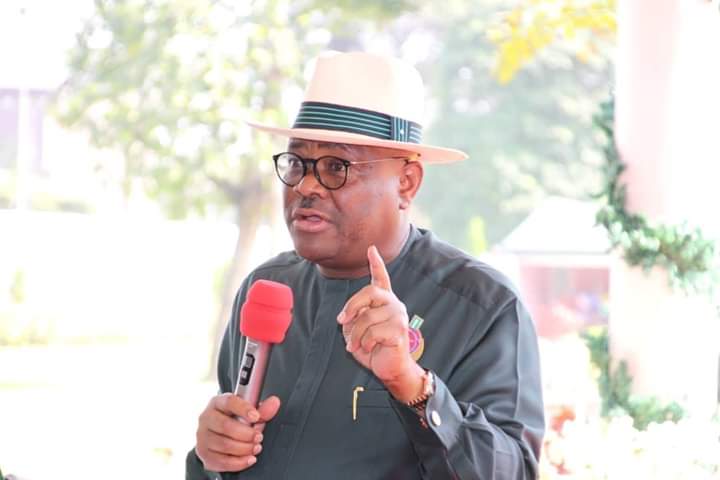
Nyesom Wike, the Federal Capital Territory (FCT) Minister, seems to thrive on conflict, and his current trajectory suggests a high-stakes confrontation with President Bola Ahmed Tinubu may be on the horizon.
Known for his combative political style and public outbursts, Wike’s ongoing feuds are stirring up tensions within the political establishment—tensions that could eventually put his own position in jeopardy.
A Pattern of Political Conflict
Wike’s political career has been marked by a series of intense clashes, making him a polarizing figure within Nigerian politics. The former governor of Rivers State has repeatedly shown that he relishes controversy and thrives in a climate of “tensile political stress.” Here are some of the key battles currently unfolding under his watch:
Rivalry with Governor Siminalayi Fubara: Wike’s struggle to maintain control over the political machinery in Rivers State continues, despite his official departure from the statehouse. Tensions between him and Fubara are palpable, with the latter increasingly asserting his authority.
Internal Tensions within the PDP: Wike has been embroiled in power struggles within his party, the People’s Democratic Party (PDP). His aggressive political moves have caused friction with fellow party members, drawing criticism from both old and new allies.
Conflict with Governor Bala Mohammed: The personal rivalry with Governor Bala Mohammed has also escalated. Public accusations of sabotage and intimidation have sparked a bitter feud, further complicating Wike’s relationships within the party.
Clash with Ohanaeze Ndigbo: Wike’s verbal sparring with the President-General of Ohanaeze Ndigbo, John Azuta-Mbata, has added fuel to the fire. The insults traded between the two leaders have only deepened existing divides within the political landscape.
Enduring Rivalry with Rotimi Amaechi: Despite stepping down as governor of Rivers, Wike’s feud with his predecessor, Rotimi Amaechi, continues to play out in public, with both leaders locked in a fierce contest for influence in the region.
The APC Showdown: A Threat to Tinubu’s Agenda?
Wike’s recent clash with APC National Secretary, Ajibola Basiru, signals his growing willingness to challenge the party’s top brass. In a heated exchange, Wike warned Basiru not to take his support for President Tinubu’s 2027 reelection for granted.
This remark has been widely interpreted as a veiled warning to the President himself, with Wike’s continued support being conditional on the preservation of his control over Rivers State.
This confrontation comes at a time when Wike’s influence within the APC is being questioned, and his potential to be a divisive force in the lead-up to the 2027 elections cannot be underestimated. Wike’s combative nature could very well threaten the party’s cohesion, especially if he feels his power base is being undermined.
Signals from the Presidency: A Pushback?
While Wike has remained a key ally of the Tinubu administration, signals from within the Presidency suggest a subtle pushback against his increasingly erratic behavior. Vice President Kashim Shettima recently reminded political actors that, traditionally, state governors are considered the leaders of their parties in their respective states. This comment appears to be a direct counter to Wike’s attempts to undermine Governor Fubara’s authority in Rivers.
This subtle intervention from Shettima serves as a diplomatic signal that Wike’s power may be curtailed if he continues to overstep. The contrasting relationship between Vice President Shettima and his successor, Governor Babagana Zulum—marked by loyalty and mutual respect—highlights the more stable dynamic the Presidency may prefer.
The Role of Alcohol in Wike’s Political Theatre
Some political analysts, including Kperogi, have suggested that much of Wike’s bombastic behavior is fueled by alcohol, which he allegedly consumes before making his most inflammatory statements. According to Kperogi, Wike’s “bravado” is often the result of his intoxication, and his public outbursts sometimes reveal sensitive information—such as when he recently hinted at his influence over judicial decisions in Osun State’s local government funding.
This theory suggests that Wike’s histrionics could be undermining his political credibility, especially when the lines between strategy and personal indulgence become blurred.
The End of Wike’s Political Noise?
The article concludes with a sober prediction: Wike’s increasingly erratic behavior and public spats are leading him down a dangerous path. While he may feel emboldened by his past successes and his position in the administration, the looming power of the Presidency could spell the end of his political reign. President Tinubu holds the power to remove Wike from his ministerial post, cut off his resources, and leverage his political rivals, such as Governor Fubara, to dismantle his influence.
Wike’s political “noise,” for all its attention-grabbing theatrics, may soon be silenced by the superior power and influence of the Presidency. If the current tensions escalate, Wike might find that his aggressive approach to politics has left him with fewer allies and fewer options for survival in the Nigerian political arena.
Wike’s confrontational politics have propelled him to the top, but they may also be his undoing.
If his escalating conflicts with fellow politicians and the Presidency continue, he could find himself facing an unavoidable reckoning. Whether or not he can navigate this dangerous political terrain will determine the future of his influence in Nigerian politics.