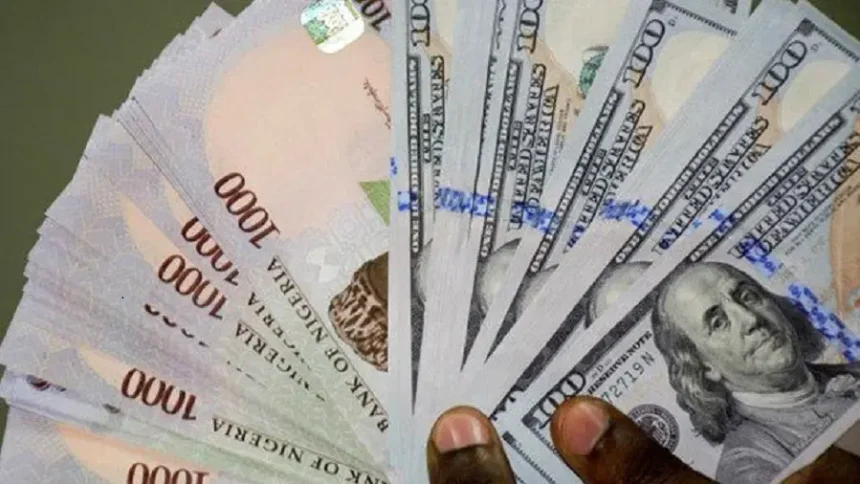
The Nigerian naira opened trading in February 2026 on a stronger footing, appreciating against the United States dollar at the official foreign exchange market amid signs of improved market alignment and sustained external buffers.
According to data published on the Central Bank of Nigeria (CBN) website, the naira closed at N1,384.5/$ on the first trading day of February, representing a modest but notable gain compared to its position at the end of January.
The appreciation reflects a gradual improvement in foreign exchange market conditions, as policymakers continue efforts to stabilise the currency and narrow the gap between the official and parallel market rates.
Market analysts note that while the movement is incremental, it signals growing confidence relative to the volatility recorded during the same period last year.
What the data shows
Data from the official foreign exchange window indicate that the naira strengthened from N1,391/$ recorded on the final trading day of January 2026 to N1,384.5/$ at the start of February.
On a year-on-year basis, the improvement is more pronounced. The naira traded around N1,500/$ at the official market on the first trading day of February 2025, highlighting a stronger opening position in 2026.
Nairametrics data further show that in early February 2025, the parallel market exchange rate weakened significantly, trading as high as N1,620/$, creating a wide gap of about N111 between the official and parallel markets.
By contrast, the parallel market opened February 2026 with the naira exchanging at approximately N1,453/$, narrowing the gap with the official rate to N62, compared with N68 recorded at the close of January.
This narrowing differential is widely viewed by market participants as a sign of relatively improved price discovery and reduced arbitrage opportunities within the foreign exchange market.
Signs of improved stability
Beyond the day-on-day movement, broader indicators suggest that the foreign exchange environment in early 2026 is more stable than the highly volatile conditions experienced in the first quarter of 2025.
Throughout February 2025, the naira consistently traded above the N1,500/$ mark at the official market, reflecting heightened pressure from demand imbalances, weak reserves at the time, and lingering confidence concerns.
In contrast, the February 2026 opening levels at both the official and parallel markets point to a comparatively firmer starting position for the local currency.
Analysts, however, caution that while the narrowing gap is encouraging, it does not eliminate underlying risks. Demand pressures, import dependency, and exposure to global financial shocks remain key factors that could influence near-term exchange rate movements.
Role of external reserves
Nigeria’s external reserves continue to play a critical role in supporting exchange rate stability and boosting confidence in the foreign exchange framework.
As of the period under review, the country’s external reserves stood at approximately $46.18 billion, providing the Central Bank with greater capacity to manage market fluctuations and intervene when necessary.
Housing TV recently reported that Nigeria’s external reserves crossed the $46 billion mark for the first time in nearly eight years, a milestone widely seen as strengthening the country’s FX buffers.
Stronger reserves enhance the CBN’s ability to smooth volatility, support liquidity, and reinforce confidence among investors and market participants.
They also contribute to sustaining improved alignment between the official and parallel markets, particularly during periods of elevated dollar demand.
Outlook
While the naira’s positive start to February 2026 offers cautious optimism, analysts stress that sustained stability will depend on a combination of consistent policy implementation, reserve management, and broader macroeconomic reforms.
Oil production levels, capital inflows, fiscal discipline, and global monetary conditions are expected to remain key drivers of currency performance in the months ahead.
For now, the naira’s early February appreciation suggests a relatively stronger footing compared with last year, even as market watchers remain alert to evolving risks.