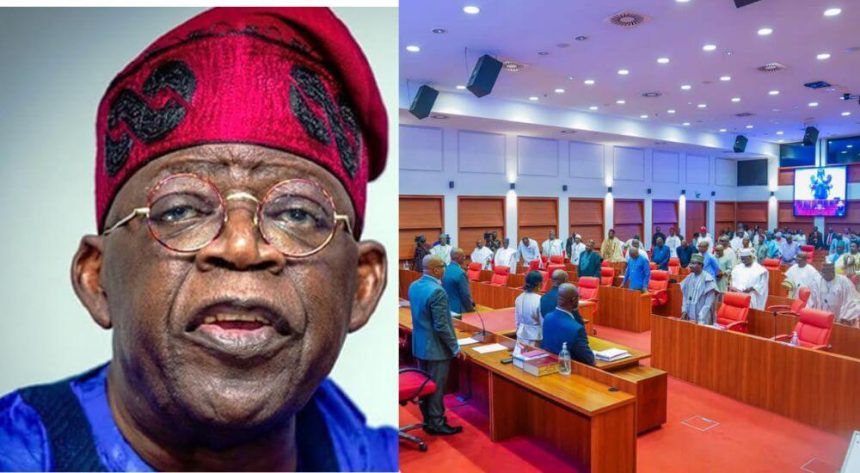
President Bola Ahmed Tinubu has appealed to the leadership of Nigeria’s 10th Senate to consider constitutional amendments that would provide a legal framework for the establishment of State Police across the federation.
The President made this call on Wednesday during an interfaith breakfast with senators at the Presidential Villa in Abuja, emphasizing that a decentralized policing structure is crucial to tackling evolving security challenges nationwide.
According to Tinubu, the creation of State Police would enhance grassroots policing, allow states to respond more effectively to local threats, and complement the existing federal security architecture.
He noted that intelligence-led, community-focused law enforcement would be better positioned to address issues such as terrorism, insurgency, and banditry.
“We are facing terrorism, banditry, and insurgency. But we will never fail to make the right response. What I ask tonight is for you, Senators, to start thinking about how best to amend the constitution to incorporate State Police so that we can secure our country, reclaim our forests from marauders, and free our children from fear,” the President said.
Tinubu highlighted the importance of collaboration between the executive and legislative arms, stressing that unity is essential to defeating insecurity in Nigeria. He praised the cordial relationship between his administration and the Senate, noting that it has facilitated the implementation of economic reforms such as fuel subsidy removal and tax policy overhauls.
“I have a lot of credit for bold reforms. Without your collaboration, those reforms would not have been possible. We are reformists together. The steps we’ve taken have eliminated monumental corruption in the subsidy system and stabilized our economy. You should be proud of these achievements,” the President added.
The President also emphasized that the State Police proposal is part of a broader strategy to ensure that security reforms keep pace with Nigeria’s changing socio-economic landscape. By empowering states to handle local security matters, the federal government hopes to reduce response times, improve intelligence gathering, and foster trust between law enforcement and communities.
Speaking in support of the initiative, Senate President Godswill Akpabio commended Tinubu for convening the interfaith breakfast and for his visionary leadership. Akpabio acknowledged the administration’s reforms, noting that they have generated additional revenue streams for governors at the sub-national level, enabling investments in critical infrastructure and social services.
“The President’s leadership at this crucial time provides the nation with a clear direction. His administration’s reforms have enhanced state-level resources, which can now be directed towards development and security,” Akpabio said. He also prayed for national peace and prosperity, reaffirming the Senate’s commitment to collaborate with the executive on vital reforms.
Security experts argue that decentralizing policing authority could be a game-changer for Nigeria, particularly in regions struggling with persistent criminal activity. State Police would allow for context-specific strategies, tailored intelligence operations, and rapid mobilization of resources in crisis situations.
However, analysts caution that the successful implementation of State Police requires clear legislative guidelines, adequate funding, and oversight mechanisms to prevent abuse of power. Constitutional amendments would need to define the operational scope, accountability structures, and coordination with federal law enforcement agencies.
Civil society groups have long advocated for the establishment of State Police, citing the limitations of the centralized Nigeria Police Force in addressing local security threats. Proponents argue that the current model often leads to delayed responses and overstretched personnel, particularly in remote or high-risk areas.
Tinubu’s call to the Senate marks a critical step in translating these discussions into actionable policy. By initiating the legislative process to amend the constitution, the President hopes to create a legal foundation for state-level security forces that can operate alongside federal agencies while respecting human rights and promoting community engagement.
As Nigeria grapples with complex security challenges, the debate over State Police highlights the need for innovative solutions that balance federal oversight with local responsiveness. Experts contend that successful decentralization could not only reduce crime rates but also improve public confidence in law enforcement, support economic activities, and strengthen democratic governance.
In conclusion, President Tinubu’s appeal to the Senate underscores the urgency of reforming Nigeria’s security architecture. By amending the constitution to accommodate State Police, the government aims to empower states, enhance law enforcement efficiency, and provide a safer environment for citizens, businesses, and communities across the country.