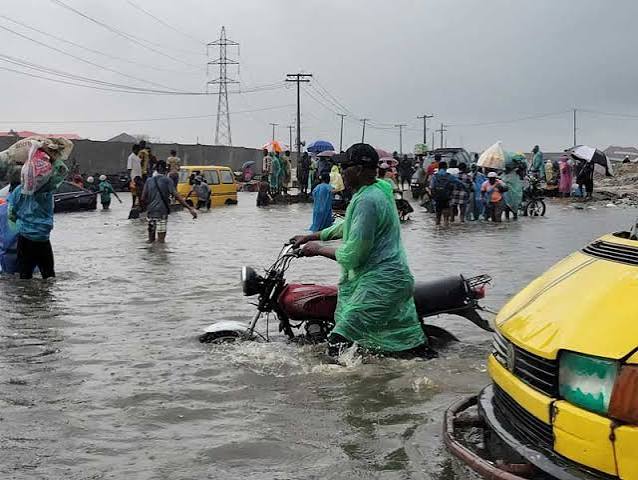
Recurring floods across Lagos have once again raised concerns over the city’s ability to cope with heavy rainfall, with experts blaming a combination of rapid urbanisation, poor planning, disappearing wetlands and inadequate flood-control infrastructure for the persistent problem.
Recent downpours left several communities, including Kunsela Road in Ikate, Gbagada, Ologolo, Ajiran, Ikorodu Road and Shogunle in Oshodi, submerged, disrupting businesses, damaging property and forcing residents to wade through floodwaters.
For many Lagosians, seasonal flooding has become a familiar reality. However, the latest incidents have reignited debate over why the commercial capital continues to experience severe flooding despite ongoing drainage projects and government interventions.
Urban planning expert, Tpl. Niyi Aderohunmu, said decades of replacing wetlands and mangrove forests with residential and commercial developments have significantly reduced Lagos’ natural ability to absorb rainwater.
According to him, wetlands once acted as natural reservoirs that stored excess rainfall and released it gradually, but large-scale development has replaced these areas with concrete surfaces that generate faster runoff.
He explained that the destruction of natural drainage channels, especially along the Lekki corridor, has made many low-lying communities increasingly vulnerable whenever heavy rainfall coincides with high tides.
Geographer Abeeb Babajide Ajagbe also described wetlands and mangroves as the city’s “natural flood infrastructure,” warning that continuous development in environmentally sensitive areas has worsened flooding.
He argued that the problem extends beyond environmental degradation, pointing to planning failures, weak enforcement and approvals granted for developments in flood-prone locations.
Environmental resource management expert Gbenga Oloniniran shared similar concerns, saying unregulated urban expansion has removed natural barriers that previously reduced the impact of flooding.
According to him, low-lying communities now experience faster surface runoff because many natural flood buffers have disappeared.
Independent researcher Tonami Playman, however, believes Lagos’ flooding cannot be blamed solely on climate change or environmental loss.
He argued that the city’s greatest challenge is the absence of large-scale flood-control infrastructure capable of storing excess stormwater during periods of intense rainfall.
Playman noted that while drainage systems are important, cities such as Tokyo, Chicago and Kuala Lumpur have significantly reduced flood risks through massive investments in underground reservoirs, storage tunnels and flood-control facilities.
He maintained that Lagos requires similar long-term infrastructure rather than relying almost entirely on drainage expansion.
Meanwhile, the Lagos State Government attributed the recurring flooding to a combination of coastal geography, climate change, rapid urbanisation and the destruction of wetlands.
Commissioner for Environment and Water Resources, Tokunbo Wahab, explained that nearly one-third of Lagos consists of lagoons, rivers, streams and swamps, making flooding difficult to eliminate completely.
He said the city naturally drains stormwater into these water bodies, but rapid development over the years has reduced the capacity of wetlands to absorb excess rainfall.
The commissioner also blamed illegal land reclamation in areas such as Ajiran, Agungi, Ikota and the Chevron corridor for obstructing natural drainage channels and worsening floods in surrounding communities.
According to Wahab, another challenge is “tidal locking,” a situation where heavy rainfall coincides with high sea levels, preventing floodwater from flowing into the Atlantic Ocean and lagoons until the tides recede.
He said the state government has intensified desilting of drainage channels, expanded flood-control infrastructure and issued flood advisories ahead of the peak rainy season to reduce the impact of flooding.
Experts, however, insist that drainage projects alone will not solve the problem.
They recommended stricter enforcement of building regulations, restoration and protection of wetlands, investment in modern flood-control infrastructure, adoption of nature-based solutions such as permeable pavements and green spaces, as well as stronger urban planning policies.
The Lagos State Government recently began demolishing structures obstructing drainage channels in Agungi, Ajiran and Ikota as part of efforts to restore waterways and reduce flooding.
The government has also unveiled plans to develop a blue-green drainage network involving canals, estate lakes and pumping stations aimed at improving flood management across the state.
Despite these measures, experts believe Lagos will continue to experience recurring floods unless long-term investments are made to strengthen both natural and engineered flood-control systems.