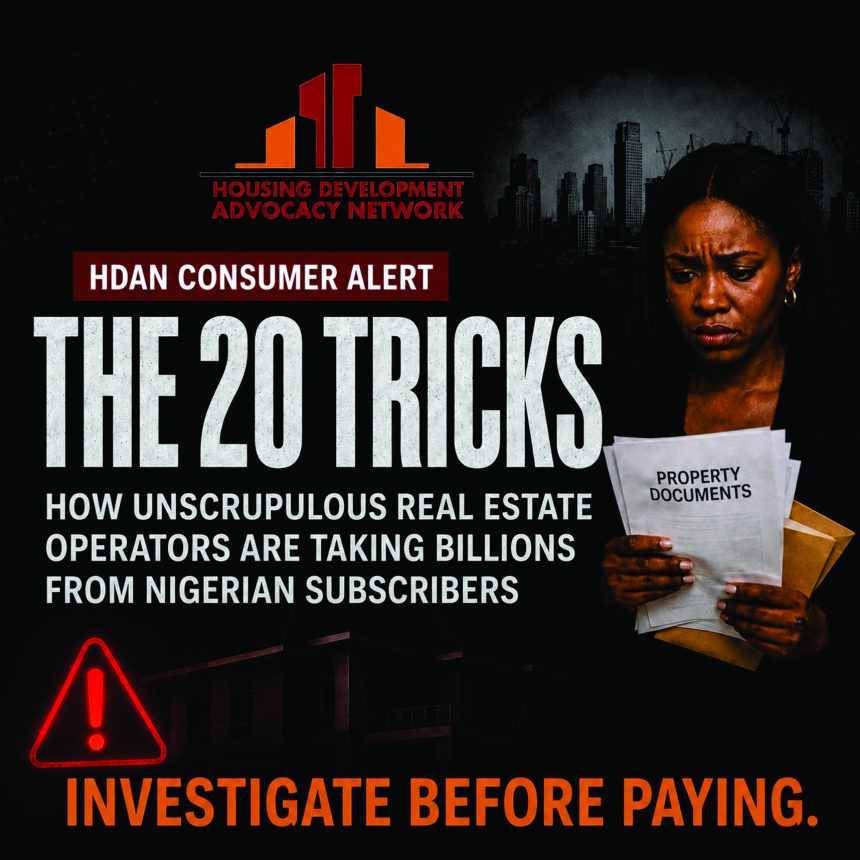
THE 20 TRICKS: HOW UNSCRUPULOUS REAL ESTATE OPERATORS ARE TAKING BILLIONS FROM NIGERIAN SUBSCRIBERS
By the Research & Economic Unit, Housing Development Advocacy Network (HDAN)
For many Nigerians, buying land or a house is the biggest financial decision they will ever make. Yet the dream of homeownership is increasingly being exploited by unscrupulous operators using sophisticated marketing, unrealistic investment promises and weak contractual protections.
THE 20 TRICKS BUYERS NEED TO WATCH
1. UNREALISTIC HIGH-RETURN PROMISES
One of the most dangerous tactics is inviting members of the public to “invest” in real estate with promises of unusually high returns, sometimes 20%, 30%, 40% or more within short periods.
Some of these schemes are structured so that money from new investors is used to pay earlier investors, creating the appearance of profitability until fresh inflows slow down.
2. SELLING LAND WITHOUT VALID TITLE
Subscribers may be offered land without proper documentation or with titles that cannot be independently verified.
3. DUPLICATE SALE OF THE SAME PLOT
The same piece of land may be sold to multiple unsuspecting buyers, creating disputes that can take years to resolve.
4. COLLECTING FULL PAYMENT WITHOUT ALLOCATION
Some subscribers make full payments but are left waiting indefinitely for their actual allocation.
5. ABANDONED OFF-PLAN PROJECTS
Developers may collect money for off-plan properties that are delayed for years or never completed.
6. HIDDEN AND UNEXPECTED CHARGES
Subscribers may discover additional charges after making payments, significantly increasing the final cost of the property.
7. REFUSING REFUNDS
Some operators make it extremely difficult for subscribers to recover their money when they decide to exit a project.
8. USING NEW PROJECTS TO FINANCE OLD ONES
Some operators launch new estates to raise money to complete older projects.
This creates a dangerous cycle:
Project B finances Project A.
Project C finances Project B.
9. CELEBRITY ENDORSEMENTS
Celebrity endorsements can create an impression of legitimacy and safety, even when buyers have not independently verified the developer or project.
10. AGGRESSIVE SALES AGENTS
Sales agents may pressure prospective buyers to make immediate payments before conducting proper due diligence.
11. “ONLY THREE PLOTS LEFT”
Artificial scarcity is often used to create urgency and discourage buyers from taking time to investigate.
12. “PRICE INCREASES TONIGHT”
Countdown promotions can pressure buyers into paying before they have verified the property, documents and contractual terms.
13. MISUSE OF “REAL-ESTATE-BACKED INVESTMENT”
Subscribers are told their investment is secured by property.
But buyers should ask:
Which specific property secures my money?
Is the title valid?
Does a legal charge exist?
Has the same asset been pledged to other investors?
14. SHOWING ONE LOCATION AND ALLOCATING ANOTHER
Some subscribers are shown one location during inspection but later discover that their allocated property is somewhere else.
15. MARKETING LAND WITH THE WRONG LAND USE
Agricultural or improperly designated land may be marketed as a residential estate.
16. ALLOCATION LETTERS THAT ARE MISTAKEN FOR LEGAL TITLE
Some buyers receive impressive allocation letters, certificates and promotional materials and assume these documents amount to legal title.
They do not.
A developer-issued allocation document cannot replace independent verification of the underlying land title.
17. UNFAIR CONTRACTS
Some agreements impose severe penalties on subscribers for late payment but provide little or no compensation when developers delay delivery for years.
18. CHANGING THE PROPERTY AFTER PURCHASE
A subscriber may buy a particular house design only to discover later that the developer has reduced the size, changed the finishes or substituted cheaper materials without meaningful consent.
19. DELAYED DELIVERY
Projects may be marketed with attractive delivery timelines, only for subscribers to wait years beyond the promised completion date.
20. FAILURE TO DISCLOSE HOW THE PROJECT IS FINANCED
Subscribers deserve to know how their money will be used and whether the project’s financial structure is sustainable.
WHAT NEEDS TO CHANGE?
Nigeria urgently needs stronger protection for real estate subscribers.
Off-plan developers should be required to disclose:
- Verified land title
- Development approvals
- Delivery schedules
- Financing arrangements
This information should be available before substantial funds are collected from the public.
Major subscriber funds should increasingly pass through escrow or controlled project accounts, with releases tied to independently verified construction milestones.
Companies inviting the public to invest for returns should also be required to demonstrate that they possess the necessary regulatory authority to solicit investments.
THE ONE RULE EVERY BUYER SHOULD KNOW
DO NOT INVESTIGATE AFTER PAYING.
INVESTIGATE BEFORE PAYING.
Before transferring money, buyers should independently verify:
- The title
- The company
- Approvals
- The contract
- The developer’s project history
- The exact location of the property
Where a company promises exceptionally high returns, prospective investors should ask the most important question:
Where exactly will the money required to pay those returns come from?
Nigeria needs genuine developers and a strong real estate industry.
But the sector cannot grow sustainably if subscribers increasingly associate property investment with deception, endless delays and lost savings.
Every fraudulent transaction damages not only the victim but also confidence in the entire housing market.
HDAN SPECIAL CONSUMER PROTECTION SERIES
In the next few days, the Housing Development Advocacy Network (HDAN) will begin spotlighting real estate developers and operators involved in documented subscriber disputes, regulatory actions, court cases and alleged fraudulent practices.
The series will examine:
- The facts of each case
- Complaints made by subscribers
- Responses from the companies involved
- Actions taken by regulators or the courts
- Warning signs prospective buyers and investors should look out for
Where allegations have not been finally determined by a court, HDAN will clearly state that fact.
THE OBJECTIVE IS SIMPLE:
To help Nigerians identify dangerous red flags, avoid questionable property schemes and protect their hard-earned money before it is too late.