


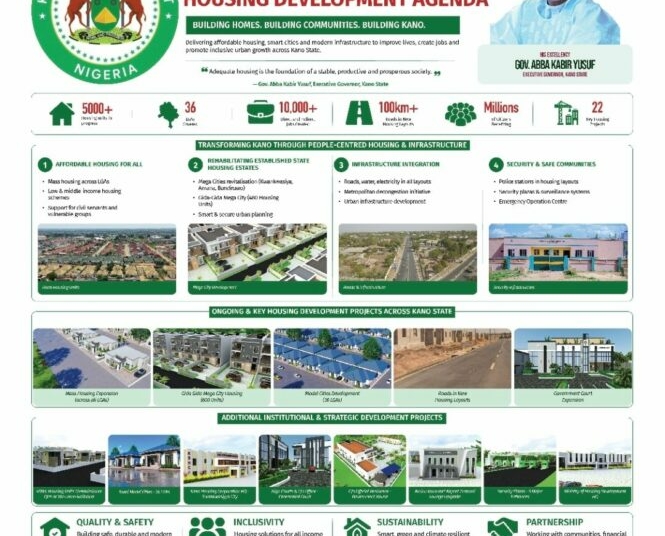
Kano Advances 5,000-Home Programme Across 36 Local Councils
The Kano State Government is implementing more than 5,000 housing units across the state’s 36 local government areas as part of an expanded housing and urban-development programme.
According to an account of the initiative, the housing units form part of a portfolio comprising 22 projects being coordinated by the Kano State Ministry of Housing Development under Governor Abba Kabir Yusuf.
The programme reportedly combines new housing construction with the rehabilitation of existing estates, infrastructure development and the delivery of public institutional buildings.
Its affordable-housing component is intended to serve low- and middle-income residents, civil servants and vulnerable households.
The state is also rehabilitating previously established housing schemes, including the Kwankwasiyya, Amana and Bandirawo mega cities, as well as the 600-unit Gida-Gida Mega City.
The government’s approach places emphasis on connecting new housing layouts to roads, water and electricity rather than constructing residential buildings without supporting infrastructure.
More than 100 kilometres of roads are reported to have been developed within the new layouts, while the wider programme is credited with generating over 10,000 direct and indirect jobs.
The projects are also expected to support efforts to reduce congestion within Kano metropolis by opening new residential areas and promoting development across the local government areas.
Security facilities planned for the housing layouts include police stations, surveillance systems, security plazas and an emergency operations centre.
Other projects within the portfolio include a 48-unit Commissioners’ Quarters at Yan Lemo/Na’ibawa and proposed rural model cities across Kano’s 36 local government areas.
The government is also developing a new headquarters for the Kano State Housing Corporation at Kwankwasiyya City.
Projects connected to the judiciary include new High Courts and a Chief Justice’s Office at the Ceremonial Court, as well as an official residence for the Chief Justice at Government House.
The programme extends to the development of security plazas at six major entrances to Kano metropolis and improvements at the protocol lounge of the Malam Aminu Kano International Airport.
If completed as planned, the geographic spread of the projects could help address the concentration of housing and infrastructure investment within the state capital.
Developing homes across all 36 local government areas could also support local economies, create construction jobs and reduce migration pressure on Kano metropolis.
However, the public impact of the programme will ultimately depend on the completion of the units, the affordability of the homes and the transparency of the beneficiary-allocation process.
Clear information about project costs, construction timelines, financing arrangements and eligibility requirements will also be necessary for residents and other stakeholders to assess the initiative’s long-term results.
The original account of the programme was identified by its publisher as branded content. The housing figures and performance claims should therefore be understood as information attributed to the project’s promoters and the article’s author.
Source: Adapted from branded content published by Leadership.
