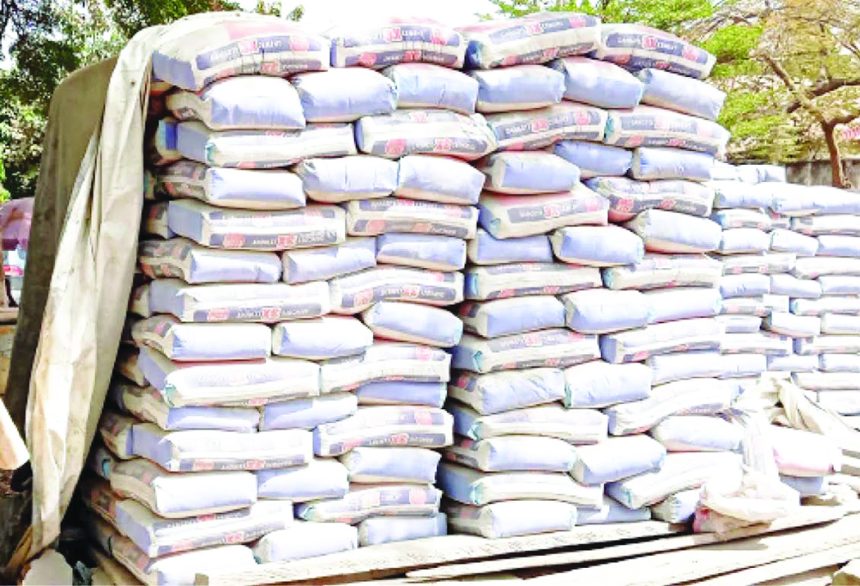
Rising construction costs are making homeownership harder for Nigerians, while the FCCPC investigates possible anti-competitive practices in the cement market.
For millions of Nigerians hoping to build homes, the rising cost of cement is making homeownership increasingly difficult.
The price of 100 bags of cement reportedly increased from approximately ₦380,000 in May 2023 to about ₦1.25 million by August 2026, representing a rise of roughly 229 per cent.
In some parts of Nigeria, a 50-kilogramme bag of cement now sells for between ₦13,000 and ₦15,000, compared with approximately ₦3,300 to ₦3,500 in 2021.
The increase has raised construction expenses for homeowners, developers and landlords, adding pressure to a housing market already facing a significant supply deficit.
Rising Cement Prices Threaten Homeownership
Cement remains a critical material in Nigeria’s conventional construction industry. Its rising cost affects the prices of blocks, foundations, columns, plastering and other building activities.
Construction professionals say the price increases have also contributed to higher property values, rents and project costs.
Amusan Oluseyi, principal partner of Space Button Architecture Limited, questioned the persistent price increases given Nigeria’s limestone reserves and cement production capacity.
John Agbezin, Public Relations Secretary of the Nigerian Institute of Quantity Surveyors, identified energy costs, foreign exchange pressures, logistics, insecurity and multiple taxation as factors affecting cement prices.
Benjamin Onigbinde, Chief Executive Officer of Sigvent Property Trust Limited, also pointed to transportation costs and the role of intermediaries between manufacturers and construction sites.
Nigeria Has Excess Cement Production Capacity
The Federal Competition and Consumer Protection Commission (FCCPC) estimates that Nigeria has installed cement production capacity of between 60 million and 65 million metric tonnes annually.
Domestic consumption, however, is estimated at approximately 25 million to 30 million metric tonnes.
The commission also identified Nigeria as a net exporter of cement to neighbouring countries.
Despite the reported production surplus, cement prices have continued to rise, prompting the FCCPC to investigate possible price manipulation and other anti-competitive practices.
The regulator said its preliminary findings did not establish wrongdoing but provided sufficient grounds for the investigation to continue.
FCCPC Investigates Cement Pricing
The FCCPC’s investigation followed public complaints about the high cost of cement in Nigeria.
The commission compared prices and market conditions in Nigeria with those in countries including Kenya, Tanzania, South Africa, Egypt, Morocco and Algeria.
According to the regulator, a 50kg bag of cement in Nigeria sold for approximately ₦9,300–₦9,700 in January 2026. By mid-year, prices had risen to between ₦10,500 and ₦13,000, reaching ₦13,000–₦15,000 in some areas by July.
Manufacturers cited energy expenses, naira depreciation, imported machinery and spare parts, transportation and logistics as contributing factors.
The FCCPC said it was examining whether those explanations adequately accounted for prevailing prices or whether the market showed evidence of coordinated conduct, abuse of market power or anti-competitive distribution practices.
The commission has issued notices of investigation and summonses requiring key industry players to provide information about pricing, production, capacity utilisation, exports and commercial relationships.
Cement Manufacturers Report Stronger Earnings
While consumers and builders face higher costs, major cement producers have reported substantial financial growth.
Dangote Cement recorded first-half 2026 revenue of ₦2.51 trillion, compared with ₦2.07 trillion in the corresponding period of the previous year. Its profit after tax reportedly increased to ₦638.53 billion.
BUA Cement also recorded higher revenue and profit during the period, while the combined profit after tax of Dangote Cement, BUA Cement and HBM Nigeria was reported at approximately ₦1.17 trillion.
The financial performance does not, by itself, establish that manufacturers engaged in unlawful pricing practices. However, the earnings have intensified public debate about competition, production costs and consumer protection.
The FCCPC’s investigation is expected to determine whether current prices reflect legitimate market conditions or potential violations of competition law.
Housing Crisis Adds Pressure
The impact of cement prices extends beyond individual construction projects.
Higher building costs can discourage developers, increase property prices and make affordable housing more difficult to deliver.
Aliyu Oroji Wamakko, a former president of the Real Estate Developers Association of Nigeria, argued that cement demand from major infrastructure projects could place additional pressure on supplies available to the housing sector.
Industry stakeholders have called for improved transportation infrastructure, reduced production costs, stronger competition and greater transparency across the cement distribution chain.
They also advocate increased support for alternative building technologies that could reduce dependence on conventional construction materials.
What Needs to Change?
Addressing cement affordability will require coordinated action involving government regulators, manufacturers, distributors and construction professionals.
Key areas for attention include:
- Greater transparency in factory-gate and retail pricing.
- Improved road infrastructure and transportation systems.
- Reliable and affordable energy supply.
- Stronger competition within the cement industry.
- Clearer oversight of distributor margins.
- Support for alternative construction technologies.
- Continued investigation of potential anti-competitive conduct.
Nigeria’s cement industry has significant production capacity and access to local raw materials. However, rising prices continue to create challenges for households seeking to build homes.
The outcome of the FCCPC investigation could provide important information about the factors driving cement prices and the measures required to make construction more affordable.