Nigeria’s three largest cement manufacturers generated a combined N6.55 trillion in revenue in the 2025 financial year, underscoring strong demand for building materials even as the country and wider Sub-Saharan Africa grapple with deepening housing and infrastructure deficits.
The companies — Dangote Cement Plc, BUA Cement Plc and Lafarge Africa Plc — recorded a 27 per cent increase over the N5.15 trillion declared in 2024, according to their audited financial statements for the year ended December 2025.
The revenue surge translated into significantly stronger profitability and higher returns to shareholders, even as policymakers continue to confront a housing shortfall estimated at over 51 million units across Africa — a figure projected to expand to 130 million units by 2030.
Revenue Breakdown
Dangote Cement retained its position as the industry leader, posting N4.31 trillion in revenue in 2025, representing a 20.28 per cent rise from N3.58 trillion in 2024.
BUA Cement followed with N1.18 trillion in revenue, marking a 35 per cent increase from N876.5 billion recorded in the prior year.
Lafarge Africa delivered the fastest growth rate among the trio, reporting N1.07 trillion in revenue, up 53.04 per cent from N696.77 billion in 2024.
The revenue growth was driven by a mix of price adjustments, capacity expansion and sustained demand linked to public infrastructure spending, particularly federal government road and transport projects executed during the year.
Profitability Surges
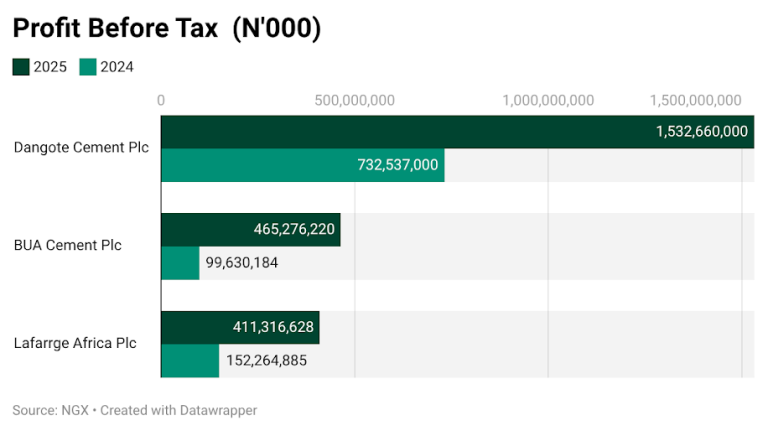
The combined profit before tax of the three firms rose to N2.41 trillion in 2025, a 145 per cent jump from N984.43 billion in 2024.
Dangote Cement accounted for N1.5 trillion in profit before tax, representing a 109 per cent increase from N732.5 billion recorded a year earlier.
BUA Cement posted N465.3 billion in profit before tax, an exceptional 367 per cent increase compared to N99.63 billion in 2024.
Lafarge Africa declared N411.32 billion in profit before tax, reflecting a 170 per cent rise from N152.26 billion in the previous year.
Industry Outlook
A report by World Cement titled Cement 2025 – Uneven Recovery projected that cement demand in Africa would grow between two and three per cent in both 2024 and 2025.
The report noted that although inflation remains elevated in several markets, expected declines in interest rates could stimulate housing demand. It highlighted strong government-backed growth in Algeria, a gradual real estate rebound in Egypt, economic stabilisation in South Africa and mixed conditions in Kenya. However, Nigerian cement demand is expected to moderate in 2025 despite interest rate cuts.
Expansion and Regional Strategy
The Chief Executive Officer of Dangote Cement, Arvind Pathak, described 2025 as a milestone year, citing the commissioning of a three million tonnes per annum grinding plant in Côte d’Ivoire during the third quarter.
He said the company recorded an 18.6 per cent increase in cement and clinker exports, executing 34 clinker shipments to Ghana and Cameroon. According to him, export terminals at Apapa and Onne remain central to the company’s ambition of achieving 10 million tonnes of combined exports by 2030.
Dangote Cement is also advancing expansion projects in Ethiopia, Cameroon, South Africa, Zambia and Senegal, while progressing construction of the six million tonnes per annum Itori plant.
BUA Cement’s Managing Director and Chief Executive Officer, Yusuf Binji, stated that ongoing projects include the Ososo Line-1 and a Sokoto regasification plant. Upon completion, the company’s installed capacity is expected to reach 20 million metric tonnes per annum, positioning it to meet rising domestic and regional demand.
Lafarge Africa announced plans to expand production lines at its Ashakacem plant in Gombe State and Sagamu plant in Ogun State. The expansion will increase capacity at Ashakacem to two million tonnes per annum and Sagamu to 3.5 million tonnes per annum.
Lafarge Africa operates four major plants with a combined installed capacity of 10.5 million tonnes annually. Its facilities are located in Ewekoro and Sagamu in Ogun State, Mfamosing in Cross River State and Ashaka in Gombe State.
Ownership Changes
In 2025, Swiss building materials group Holcim divested its 84 per cent stake in Lafarge Africa in a $1 billion transaction, selling to Chinese firm Huaxin Cement as part of a broader strategy to refocus on core growth markets.
Balancing Growth and Deficit
Despite the impressive financial performance of the cement producers, the scale of Africa’s housing and infrastructure deficit underscores a structural imbalance between supply capacity and effective housing delivery.
Rapid urbanisation, population growth and weak housing finance systems continue to constrain access to affordable homes. While cement output and corporate earnings expand, the broader challenge remains translating industrial growth into inclusive and affordable housing solutions.