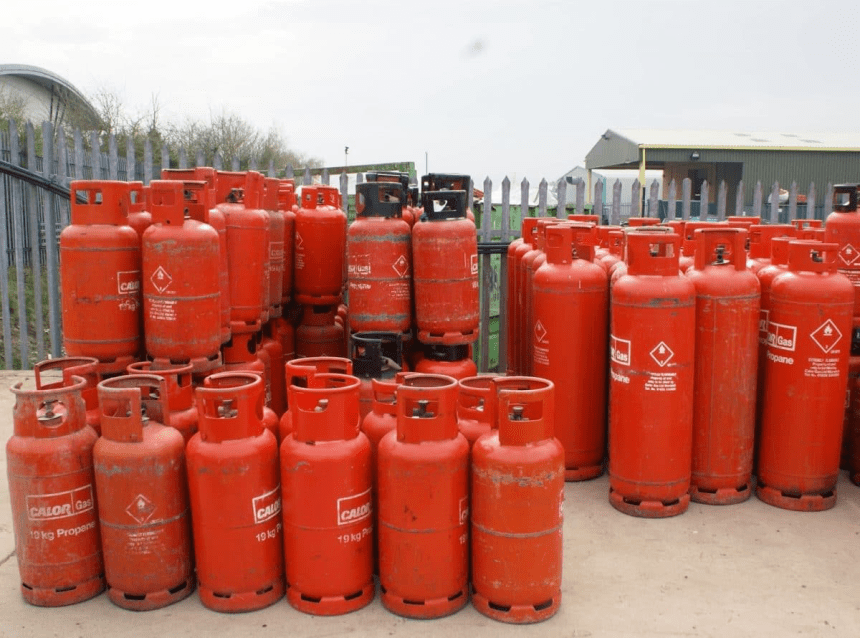
Residents of the Federal Capital Territory (FCT) are beginning to enjoy some relief as the price of Liquefied Petroleum Gas (LPG), popularly known as cooking gas, has declined after months of sustained increases.
A market survey showed that LPG now sells for between N1,498 and N1,650 per kilogram across Abuja, depending on location and retail outlet, compared to recent highs of about N2,000 per kilogram recorded in several parts of the country.
The price reduction means that refilling a 5kg cylinder now costs between N7,490 and N8,250, while a 12.5kg cylinder costs between N18,725 and N20,625. At the peak of the recent price surge, the same cylinders cost approximately N10,000 and N25,000 respectively.
Despite the decline, some roadside vendors still sell cooking gas at prices as high as N1,850 per kilogram.
Industry experts attributed the price drop to improved product availability and easing wholesale costs but warned that long-term stability depends on addressing structural challenges in Nigeria’s LPG market.
Energy economist, Dr. Dayo Abegunde, said the reduction reflects improved supply conditions but noted that Nigeria remains vulnerable to global market shocks because a significant portion of domestic LPG consumption still depends on imports.
“The recent decline is encouraging for consumers, but Nigeria must deepen domestic production and strengthen its supply chain to avoid recurring price spikes whenever there are disruptions in the global market,” he said.
Oil and gas analyst, Edward Bulus, also stressed the need for increased domestic refining and retention of locally produced LPG within the Nigerian market to guarantee sustainable price stability.
LPG marketers confirmed that improved supply at coastal depots and a gradual decline in wholesale prices have contributed to the moderation in retail prices.
An Abuja-based LPG marketer, Bassey Etanem, said increased product availability is gradually filtering through the distribution chain, resulting in lower prices for consumers.
Retail operators in Abuja also attributed the decline to growing competition among filling plants as supply conditions improve.
However, marketers warned that transportation and logistics costs remain high, particularly for operators supplying inland locations, adding that investments in storage and distribution infrastructure are necessary to sustain lower prices.
Many consumers welcomed the reduction but argued that cooking gas remains expensive compared to previous years.
Some residents said they were forced to switch to charcoal and firewood when LPG prices approached N2,000 per kilogram.
A trader, Grace Bade, called on the government to implement measures that would further reduce the cost of cooking gas and ease the economic burden on households.
The recent price moderation follows intervention measures announced by the Federal Government to address supply shortages and market manipulation.
Minister of State for Petroleum Resources (Gas), Ekperikpe Ekpo, directed the Nigerian Midstream and Downstream Petroleum Regulatory Authority (NMDPRA), regulators and security agencies to intensify surveillance of the LPG market, investigate hoarding and diversion, and sanction operators found manipulating prices.
The minister said the government remains committed to increasing domestic LPG supply, reducing dependence on imports and ensuring that locally produced gas is prioritised for domestic consumption.
He also disclosed plans for a local LPG blending initiative involving Nigeria LNG Limited (NLNG), indigenous producers and operators of the Port Harcourt LPG plant to improve supply reliability and reduce logistics costs.
The NMDPRA had earlier linked the spike in cooking gas prices to global supply disruptions, exchange rate pressures, logistics bottlenecks and market inefficiencies.
Industry stakeholders, however, maintain that sustained affordability will depend on expanding domestic production, improving infrastructure and strengthening distribution networks across the country.