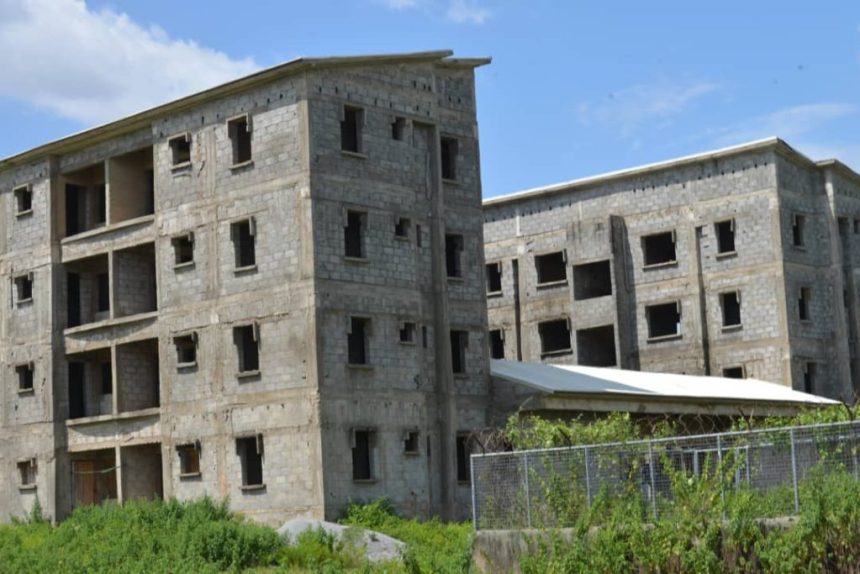
The Federal Government has commenced a fresh assessment of abandoned housing estates across Nigeria, with plans to rehabilitate, upgrade and complete viable projects built with public funds.
The Minister of Housing and Urban Development, Engr. Muttaqa Rabe Darma, announced the initiative while inspecting the abandoned National Housing Programme (NHP) estate in the Kubwa-Karsana District of the Federal Capital Territory.
Darma said the inspection formed part of a nationwide assessment of neglected Federal Government housing assets under the Renewed Hope Housing Agenda.
According to the Minister, the exercise is intended to identify housing projects that can be revived and returned to productive use rather than allowing public assets to deteriorate.
The Federal Government’s latest approach places emphasis on recovering existing investments alongside the construction of new housing projects.
FG To Assess Abandoned Housing Projects
Darma expressed concern over the continued abandonment of government-funded housing projects, saying public assets should be completed and made available to Nigerians.
“We cannot continue to allow housing projects that were started with public funds to remain abandoned. These are assets belonging to Nigerians, and our responsibility is to ensure that they are completed, functional and occupied by the people who need them,” he said.
The Minister said the Ministry is reviewing abandoned housing projects across the country to determine their current condition, level of completion and the interventions required to restore them.
The assessment is expected to provide information that will help the government determine which projects are viable for rehabilitation and completion.
The Ministry did not provide a nationwide figure for the number of abandoned housing projects covered by the exercise.
Viable Estates To Be Upgraded
Darma said projects found to be viable would be upgraded and completed as part of the Federal Government’s efforts to expand housing supply.
“Our target is clear. Where projects are viable, we will upgrade them, complete them and ensure that Nigerians can benefit from them,” he said.
He added that the government was determined to deliver more homes and reduce the housing deficit before the end of 2026.
The Minister did not provide a detailed list of the projects being assessed or the estimated cost of rehabilitating the abandoned estates.
Those details would depend on the outcome of the assessment and technical evaluation of individual projects.
Renewed Hope Housing Agenda
The nationwide assessment forms part of the Federal Government’s broader Renewed Hope Housing Agenda.
The Ministry has been implementing new housing developments while also inspecting projects across different parts of the country.
In June, Darma inspected the Renewed Hope City project in Ibeju-Lekki, Lagos, which comprises 2,084 housing units. The Ministry said the project was being delivered through a public-private partnership, with FMBN financing 1,500 units.
The Minister said at the time that the nationwide inspections were intended to establish project status, identify challenges and determine the steps required to ensure timely completion.
The current assessment of abandoned estates extends that approach to projects that have stalled or remained unused.
Government Wants To Protect Public Investments
The Housing Ministry said recovering abandoned projects would help prevent public resources already invested in housing from being wasted.
Rather than allowing partially completed estates to deteriorate, the government wants to determine whether existing structures can be rehabilitated and brought into use.
Darma said completing viable abandoned projects would complement the construction of new estates and enable government to increase the number of available housing units more efficiently.
This approach could also reduce the time and resources required to provide housing where usable infrastructure and partially completed structures already exist.
However, the Ministry has not disclosed the specific criteria it will use to determine whether an abandoned project is considered viable.
Allocation To Be Transparent
The Minister also assured that houses recovered and completed under the programme would be allocated transparently to deserving Nigerians.
He said allocation would be carried out in line with the objectives of the Renewed Hope Housing Agenda.
The statement did not provide details of the proposed allocation process, eligibility requirements or whether previous beneficiaries connected to some of the abandoned projects would receive priority.
Those details could become clearer after the Ministry completes its assessment and develops strategies for individual projects.
Housing Delivery Through Existing Assets
The Federal Government’s decision to assess abandoned estates reflects a dual approach to housing delivery.
One part involves developing new housing projects, while the other focuses on recovering existing government investments.
Recent housing interventions demonstrate the government’s continued emphasis on completing and allocating existing projects.
Earlier in September, the Federal Mortgage Bank of Nigeria handed over 129 completed three-bedroom bungalow units at the Nasarawa Technology Village under its Rent-to-Own Scheme. The project was linked to a wider intervention for beneficiaries who had previously been unable to take possession of their homes.
The Minister described that handover as evidence of what could be achieved through collaboration among public institutions, financiers, private developers and state governments.
The abandoned-estates initiative similarly focuses on turning existing housing investments into usable homes.
Previous Inspections Revealed Project Challenges
Darma’s nationwide inspections have previously exposed gaps between reported project progress and conditions observed on the ground.
In June, an inspection of a Federal Government housing project in Katsina found that only about 130 of 250 units described in official progress reports as completed were actually finished, according to Premium Times. The inspection also identified concerns about deterioration in some structures.
The Minister subsequently directed officials to conduct a comprehensive audit of the project, including the contractors involved, contract terms, amounts released and actual completion levels.
That experience underscores the importance of physical verification when assessing abandoned or incomplete housing projects.
For the current nationwide exercise, the Ministry says it intends to establish the condition and status of abandoned Federal Government housing assets before deciding on appropriate interventions.
Kubwa-Karsana Estate Under Review
The Kubwa-Karsana inspection is one of the latest steps in the Ministry’s assessment.
The estate is part of the Federal Government’s housing infrastructure in the Federal Capital Territory.
Darma’s inspection is expected to help the Ministry determine the level of work already completed at the site and what would be required to make the development functional.
The government has not yet announced the estimated cost of completing the Kubwa-Karsana estate or a specific completion date.
It has also not disclosed the number of housing units at the inspected site in the latest statement.
The focus, according to the Minister, is first to establish the status of the asset and determine whether it can be successfully revived.
Wider Housing Challenge
Nigeria continues to face significant demand for affordable housing, making the recovery of stalled public projects an important part of housing policy discussions.
The Federal Government has also been pursuing new housing developments, financing interventions and partnerships with private-sector developers.
In June, the Housing Ministry said it was implementing six Renewed Hope Cities, one in each geopolitical zone, alongside Renewed Hope Estates in 12 locations across the country.
The Ministry’s current approach therefore combines new construction with efforts to recover older public housing investments.
The success of the abandoned-estates initiative will depend on the condition of individual projects, available funding, contractor performance, land and infrastructure issues, and the government’s ability to complete and allocate the revived units.
Government Seeks Faster Housing Delivery
Darma said the recovery programme would support the government’s objective of increasing housing supply and improving access to affordable homes.
He said rehabilitating viable abandoned estates would allow the government to make better use of public investments while increasing the number of completed housing units available to citizens.
The Minister also emphasised the need to improve existing housing infrastructure and bring viable projects back into use.
The Ministry is expected to continue inspecting abandoned Federal Government housing assets across the country as it develops strategies for rehabilitation, completion and eventual allocation.
For Nigerians who have questioned why publicly funded housing projects are allowed to remain unused or deteriorate, the exercise represents a renewed attempt to place existing assets back into the housing supply pipeline.
However, the extent of the programme will only become clearer as the Ministry publishes the results of its nationwide assessment, identifies projects for intervention and provides details on funding, completion timelines and allocation.
For now, the Federal Government has stated that viable abandoned housing projects will be assessed, upgraded and completed, with the ultimate objective of making the recovered homes available to Nigerians.