


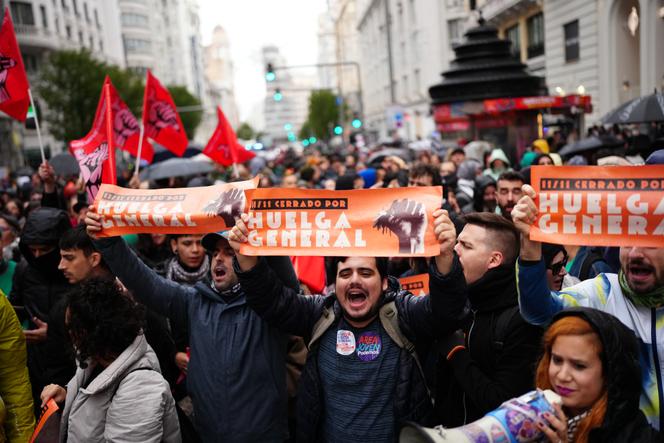
Spain has been hit by its first nationwide 24-hour strike since 2012, with trade unions reporting massive participation as workers demand action on rising housing costs, wages and public services.
The industrial action has disrupted transport services, with pickets organised at logistics centres, industrial estates and major motorways across the country.
However, business leaders have downplayed the scale of participation, describing the impact as limited in most sectors.
The strike’s impact and the size of demonstrations planned in Madrid and Barcelona are being closely watched ahead of the November 29 election, which opinion polls suggest the right-wing opposition could win.
In Madrid, dozens of protesters braved heavy rain to block a major road leading into the city centre, causing traffic congestion. However, many shops continued operating normally.
Public transport services also experienced disruptions despite minimum service requirements for commuter trains, metro systems and buses.
In Barcelona, metro and bus services were suspended until late afternoon after operating at minimum capacity during the morning rush hour.
Madrid’s metro, by contrast, reported that 93 per cent of its trains operated in the early morning, although passenger numbers dropped by approximately half.
Unions Describe Participation As Massive
UGT union leader Pepe Alvarez described participation in the strike as “massive”, claiming that some regions experienced a total stoppage.
Speaking to public broadcaster RTVE, Alvarez said the action had been a huge success.
However, UGT spokesman Rafael Espartero acknowledged that participation varied across the country.
He said mobilisation was particularly strong in car manufacturing, petrochemicals and meat processing, as well as coastal regions where housing difficulties were severe.
The CEOE, an organisation representing business leaders, offered a different assessment, saying participation was low in most sectors and varied by region and occupation.
Housing Crisis Sparks Nationwide Protests
The UGT and CCOO unions called the strike following nationwide protests over access to affordable housing.
The demonstrations were triggered by the September eviction of an 87-year-old pensioner in Madrid.
Protesters subsequently occupied the capital’s central Puerta del Sol square for five weeks, erecting hundreds of tents. Similar demonstrations later emerged in other cities.
The protests increased pressure on Socialist Prime Minister Pedro Sanchez, whose minority government failed to secure parliamentary approval for a package of housing measures introduced in response to public demands.
Sanchez called an early election, originally scheduled for 2027, after the legislative setback.
The prime minister, who has governed since 2018, has urged voters to defend public healthcare, the eight-hour working day and pension rights.
His Socialist Party has warned that a right-wing victory could threaten some of these protections.
However, the unions insist the strike is directed at all levels of government and not exclusively against the political right, which opposed the government’s housing decrees.
“The Socialists and the main right-wing opposition Popular Party (PP) must listen to us, because the streets are speaking clearly,” Alvarez said.
Opposition Rejects Strike
Business groups and opposition politicians have criticised the industrial action, describing it as an election-related political move rather than a genuine labour dispute.
Popular Party leader Alberto Nunez Feijoo, who leads most opinion polls, warned that unions risked being permanently associated with Sanchez if they proceeded with the strike.
Feijoo also described the industrial action as a “serious mistake” following a high-speed train collision in central Spain last month that killed 69 people.
Union leaders have defended the strike as an exceptional measure designed to increase pressure on political leaders to address the country’s housing challenges.
Unions Demand More Public Housing And Rent Controls
The unions are demanding an expansion of public housing, a ban on evicting vulnerable tenants and stronger rent controls.
They are also calling for restrictions on tourist accommodation in areas experiencing severe housing pressure.
The demands reflect growing concerns over housing affordability and access to accommodation, which have become major issues in Spain’s political debate.
The November 29 election is expected to provide another test of public sentiment towards the government’s response to the crisis and the opposition’s proposed alternatives.