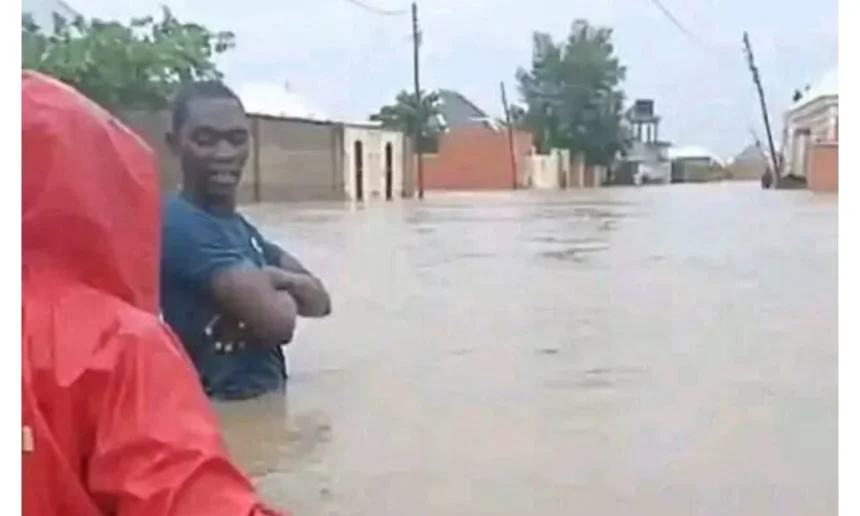
Flooding has destroyed residential homes, rice farms and other property in five agrarian communities in Lafiagi, Edu Local Government Area of Kwara State, leaving residents counting their losses.
The affected communities are Pututa, Tswako, Likpata, Godangi and Ekko, all within Lafiagi Ward 4.
The flooding followed heavy rainfall on Tuesday and affected homes, farmlands and other community infrastructure.
No lives were reportedly lost in the incident, but residents suffered significant damage to property and agricultural produce, with rice farms among the affected farmlands. A source of drinking water was also destroyed.
The flooding has renewed concerns over the vulnerability of riverine communities in Kwara North, particularly those located around the River Niger basin.
Governor visits affected communities
Kwara State Governor AbdulRahman AbdulRazaq visited Pututa and other affected communities to assess the situation and sympathise with residents.
Speaking at the palace of the Emir of Lafiagi, Alhaji Muhammed Kudu Kawu, the governor described the recurring flooding as unfortunate.
He said the state was concerned about the destruction caused by the latest incident and noted that the government was working to provide support to affected residents.
“The purpose of this visit is to come and commiserate with the communities over the flood incident and to see how we can bring succour to the affected communities,” AbdulRazaq said.
He said the absence of fatalities was welcome but acknowledged that significant property had been destroyed.
The governor also identified the dredging of the River Niger as a possible long-term measure for addressing recurring flooding in the area.
According to him, dredging is beyond the capacity of the state government alone, but the state would continue to engage relevant federal agencies for support.
These include the Ministry of Marine and Blue Economy, the National Inland Waterways Authority and the Hydro-Electric Power Producing Areas Development Commission.
SEMA ordered to assess losses
AbdulRazaq directed the Kwara State Emergency Management Agency to visit the affected communities and document the losses recorded during the flooding.
The assessment is expected to provide information on the extent of damage to homes, farms and other property and help determine the assistance required by affected residents.
The governor also announced N10 million in immediate support for residents of Pututa.
The money is intended to help provide basic needs, including food, medical assistance and drinking water, following the destruction caused by the flood.
PUNCH had earlier reported that the state government described the N10 million intervention as part of its immediate response to the disaster after floodwater submerged parts of Pututa.
Rice farms washed away
The flooding also caused losses for farmers whose rice farms were affected by the rising water.
The five affected communities are predominantly agrarian, meaning that damage to farmland could have wider consequences for household incomes and local food production.
Residents said the floodwater washed away crops and affected agricultural land that communities depend on for their livelihoods.
The destruction of a drinking-water source has also created an additional concern for residents who need access to safe water in the aftermath of the flooding.
Communities seek lasting solution
Residents of the affected communities have called for more permanent measures to prevent recurring flooding.
The communities are located in a riverine area, and residents have experienced flooding during periods of heavy rainfall.
The head of Pututa, Alhaji Muhammed Manko Ibrahim, appealed to the state government to assist the community in finding a lasting solution to the problem.
Lafiagi Ward 4 contains about 31 villages, according to the head of the Pututa community, who said the riverine nature of the area makes residents particularly vulnerable to flooding.
The governor’s proposal to pursue the dredging of the River Niger has therefore become part of the wider discussion around long-term flood management in the area.
Radio Nigeria also reported that AbdulRazaq described dredging of the River Niger as a lasting solution and said the state would continue engaging federal agencies over the matter.
Flooding remains a recurring risk
The latest incident highlights the continuing flood risk facing communities located along the River Niger and other waterways.
While emergency assistance can help affected families recover from immediate losses, residents and authorities continue to face the challenge of finding longer-term measures to reduce the impact of flooding.
Such measures may include improved flood monitoring, protection of waterways, resilient infrastructure and better preparedness in vulnerable communities.
For the affected residents of Pututa, Tswako, Likpata, Godangi and Ekko, the immediate priority remains recovery from the latest disaster, replacement of damaged property and farmland, and access to food, water and other basic necessities.
The state government’s damage assessment and emergency support are expected to provide the basis for further intervention as residents begin to recover from the flooding.