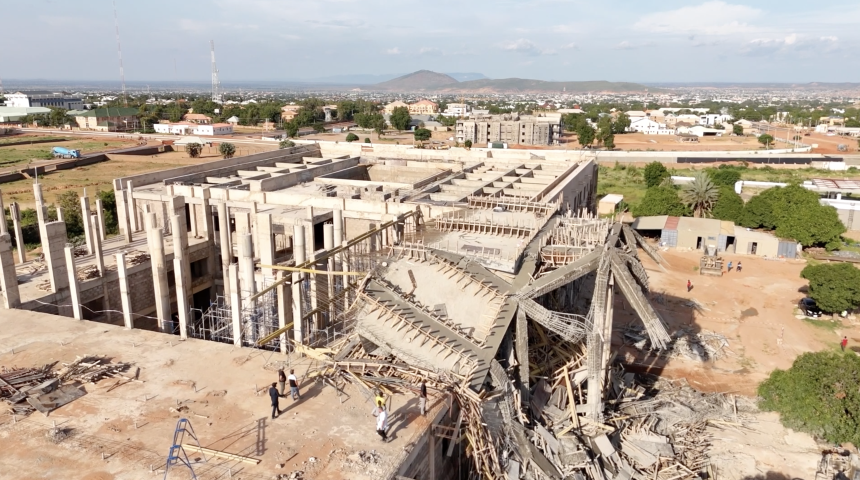
The Council for the Regulation of Engineering in Nigeria, COREN, has cleared the structural design and materials used for the ongoing Gombe State House of Assembly Complex, attributing the collapse of its entrance canopy to deficiencies in construction procedures and temporary support arrangements.
The findings were contained in the report of an eight-member COREN investigation panel constituted to examine the collapse of the reinforced concrete cantilevered entrance canopy at the project site.
The incident occurred while fresh concrete was being placed on the canopy, resulting in the death of one worker and injuries to seven others. The injured workers were taken to the Gombe State Specialist Hospital and the Federal Teaching Hospital in Gombe.
The investigation examined the project’s structural design, reinforcement detailing, concrete test results, working drawings, construction sequence, temporary formwork and propping arrangements.
Presenting the report to the Gombe State Government, COREN National Registrar, Okorie Austin Uche, said the panel found that the consulting structural engineer was qualified and that the structural design had been checked and sealed.
However, the investigation identified deficiencies in the way the work was executed.
Construction sequence identified as key factor
According to COREN, the temporary formwork and construction sequence were among the probable contributing factors to the collapse.
The panel found that the canopy was cast at once instead of having the concrete placed progressively in stages. This placed significant demands on the temporary support system during the concrete placement process.
COREN said the temporary formwork was a critical part of the load-bearing arrangement while the fresh concrete was being placed.
The investigation also found that the contractor had failed to engage registered relevant professionals, including engineers and architects, on the project.
The panel further established that although the structural drawings had been checked and sealed by the consulting structural engineer, the working drawings had not received approval from the relevant approval authority.
Materials found to be adequate
The investigation did not find the concrete or reinforcement materials responsible for the collapse.
COREN said an assessment of the concrete test results showed that the concrete had adequate compressive strength. Integrity tests conducted on the standing structure also supported the finding that the remaining structure was technically adequate.
The reinforcement bars found at the site were similarly assessed and found to be consistent with the sizes and quality specified in the structural drawings.
The findings therefore cleared the design and materials from being the primary cause of the canopy failure, while drawing attention to the manner in which the construction work was executed.
Construction cleared to resume
Following the integrity assessment, COREN cleared the standing structure for construction to continue.
However, the resumption is subject to stronger professional supervision and the involvement of properly qualified and registered professionals.
The panel recommended that the contractor and consultant ensure adequate professional oversight throughout the remaining stages of the project.
The Gombe State Government has pledged to implement the recommendations.
Receiving the report on behalf of Governor Inuwa Yahaya, Deputy Governor Manassah Jatau said the government deliberately allowed the technical investigation to run its course before taking further action on the project.
He said the recommendations would be carefully studied and implemented as construction resumes.
The deputy governor also stressed that the government was not in a hurry to complete the project at the expense of quality and safety.
COREN calls for stronger professional supervision
COREN said the incident also highlighted the importance of professional mentorship and supervision in the engineering sector.
The council noted that completing university training is not, by itself, sufficient preparation for independent engineering practice and stressed the importance of practical experience under qualified professionals before engineers receive full professional responsibility.
The council also urged government to ensure that engineering contracts are executed with the involvement of properly licensed professionals.
The COREN panel said the investigation lasted about two months, with part of the period required to clear the collapsed structure and conduct the necessary technical assessments.
The Gombe Assembly Complex can now proceed with construction, but under enhanced professional supervision and closer adherence to approved engineering procedures.
The findings also provide a reminder of the importance of proper temporary works, approved working drawings, appropriate construction sequencing and qualified professional supervision in the execution of major public infrastructure projects.