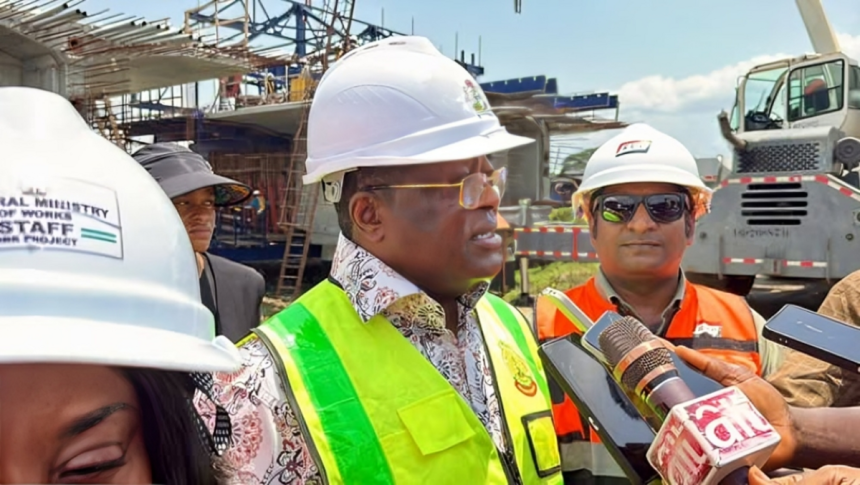
Minister of Works, Senator Dave Umahi, has said the reinforced concrete pavement being deployed on the Lagos-Calabar Coastal Highway is designed to last between 50 and 100 years with minimal maintenance.
Umahi said the technology forms part of the Federal Government’s strategy to construct roads capable of handling heavy traffic while reducing the need for frequent reconstruction.
“We are talking of 50 to 100-year guarantee for reinforced concrete pavement, with low maintenance,” the minister said.
According to him, the durability of the pavement is particularly important for major economic corridors expected to carry heavy commercial traffic.
55km Coastal Highway Section Nears Concrete Pavement Completion
Umahi disclosed that construction work on the 55-kilometre Section Two of the Lagos-Calabar Coastal Highway is progressing, with the concrete pavement expected to be completed in November.
He, however, said some bridges and flyovers would require additional time because of engineering challenges around the Dangote Refinery and Lekki Deep Sea Port corridors.
The minister explained that the structures must be designed to accommodate heavy-duty trucks while also taking the soil conditions in the area into consideration.
Government Plans Drainage Works
Umahi also disclosed plans to address drainage concerns along the completed section of the highway.
He said service lanes and drainage channels were being incorporated to improve the evacuation of floodwater from the coastal corridor.
“We are creating five-foot drainage channels on both sides, and culverts will cross the coastal highway to connect to Lagos State drainage channels that lead to the lagoon,” he said.
The minister maintained that the highway was designed to withstand the environmental and traffic pressures associated with the coastal corridor.
The Federal Ministry of Finance has similarly stated that the highway is being constructed with continuously reinforced concrete pavement designed for a minimum lifespan of 50 years with minimal maintenance.