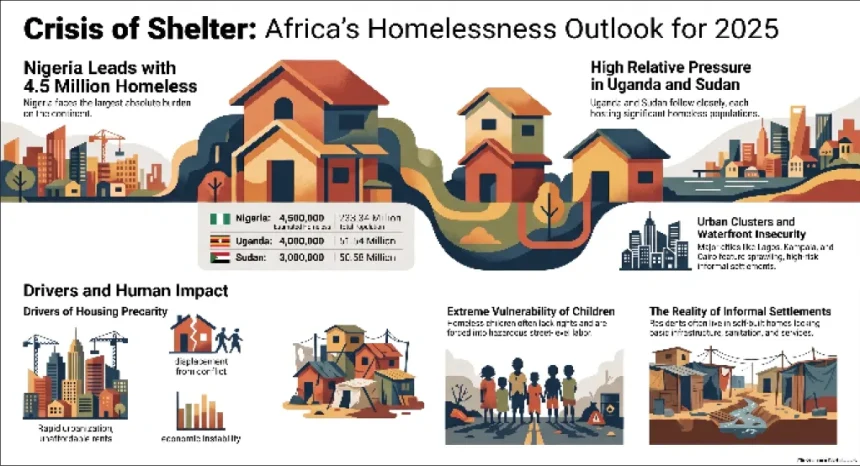
Nigeria Leads Africa in Homeless Population With 4.5 Million People
Nigeria has been ranked as the African country with the highest estimated homeless population, with about 4.5 million people classified as homeless in 2025, according to data from the World Population Review cited by Daily Trust.
The figure places Nigeria ahead of other African countries facing significant homelessness challenges, including Uganda and Sudan. Uganda is estimated to have about four million homeless people, while Sudan has approximately three million.
The figures highlight the scale of Nigeria’s housing challenges as rapid urbanisation, rising rents and population movement continue to place pressure on available accommodation.
Major cities, including Lagos, Abuja and Kano, are among the urban centres affected by the shortage of affordable housing, with growing numbers of people struggling to secure accommodation within their means.
The situation also raises concerns about the conditions under which people without stable shelter are forced to live.
Children are particularly vulnerable, with homelessness and the lack of stable accommodation exposing some to street life and hazardous forms of work. UNICEF has highlighted the risks faced by vulnerable children who lack adequate shelter and protection.
Nigeria’s position in the ranking comes against the background of a broader housing crisis across Africa. Rapid population growth and urbanisation have increased demand for housing, while the supply of affordable and adequate accommodation has struggled to keep pace.
The pressure is particularly pronounced in major cities, where high rents and limited access to affordable homes have made housing increasingly difficult for low-income households.
The data also comes amid continuing concerns about Nigeria’s housing deficit and the cost of providing new homes.
The World Population Review’s homelessness figures have varied by data year and methodology. Its current country table, for example, lists Nigeria’s larger 24.4 million estimate against a 2020 data year, underscoring the importance of considering the underlying year and definition when comparing homelessness figures internationally.
A separate United Nations report has also cited an estimate of more than 24.4 million homeless people in Nigeria, while noting that Africa faces a wider housing crisis driven by rapid urbanisation and the growth of informal settlements.
The housing situation is further complicated by the cost of construction, land acquisition, infrastructure and property registration, all of which can affect the pace at which new housing is supplied.
Addressing homelessness therefore requires not only increasing the number of homes available but also ensuring that new housing is affordable and accessible to households that need it most.
With Nigeria’s population continuing to grow and urban centres attracting people in search of jobs and better opportunities, the demand for affordable housing is expected to remain a major challenge for policymakers, developers and communities.