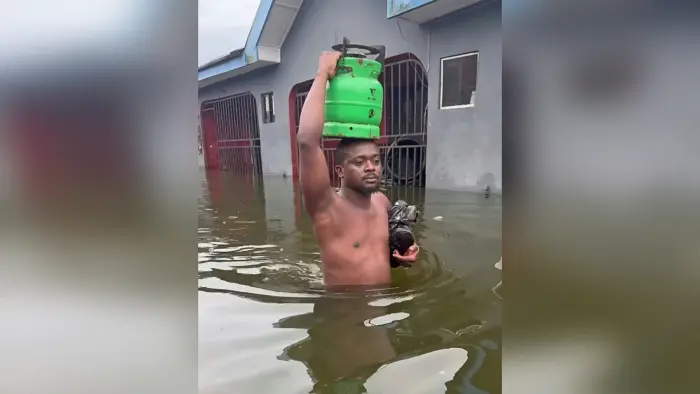
Flooding has displaced families, disrupted schools and businesses and submerged homes and roads across parts of Rivers and Delta states following days of heavy rainfall.
In Rivers State, several communities in Port Harcourt and Obio/Akpor Local Government Area have been badly affected, with residents forced to leave their homes and seek temporary shelter in vehicles, uncompleted buildings and other locations.
For Vivian Onyeije, a mother of four from Rumusita in Eneka, Obio/Akpor, the flooding has forced her family from one temporary shelter to another.
Floodwater first entered her home and rose to waist level, forcing her to leave with her children. She moved to her shop, but the water reached there two days later.
The family then moved into an uncompleted building around the Rumopku axis, only to be forced out again after another heavy downpour submerged the surrounding area.
The family eventually resorted to sleeping in their vehicle.
Her experience reflects the situation facing several families across parts of Rivers State, where floodwaters have submerged residential areas, businesses and roads, leaving residents searching for alternative accommodation.
The Guardian reported that hundreds of families across Port Harcourt and neighbouring communities have been affected, with some residents relocating to villages because of the flooding and rising accommodation costs.
Schools forced to close
The flooding has also disrupted education in affected communities.
At Rumuakoara Community Secondary School in Nkpolu, Obio/Akpor, rising water forced teachers and students to leave the school premises.
Several schools in Rumusita along the Eneka axis were also affected, disrupting academic activities and preventing many children from attending classes.
Residents said the situation had affected both public and private schools in the area, while some churches and other community facilities also suspended activities because access had become difficult.
Businesses and public facilities affected
Businesses in areas including Nkpolu and Rumuekini have been forced to close as floodwater spread through roads and commercial areas.
Churches, mosques and other public facilities around Ozouba and Nkpolu were also affected, with some closing while others recorded reduced activities.
A wedding venue in GRA, Port Harcourt, was among facilities affected by the flooding.
The University of Port Harcourt has also experienced flooding around parts of its premises, although the institution said the water usually drains towards the Choba River after rainfall stops.
The university’s Public Relations Officer, Dr Sam Kpenu, explained that prolonged rainfall makes the situation worse because the water does not have enough time to drain away.
Several roads and communities submerged
The flooding has affected a wide range of communities and major roads across Port Harcourt and its surrounding areas.
Areas reported to have been affected include Uzoba, Rumuekini, Choba, Eneka, Stadium Road, NTA Road, Mgboba, GRA, Chokocho in Etche, Peter Odili Road, Rupokwu, Alakahia, Oyigbo, Atali, Rumuparali, Ogbogoro, Egbelu, Cornerstone, Iwofe, Rumulumeni, Rumoaholi and Elikpokwu.
Several buildings have been submerged, while some structures in Rumuekini reportedly developed cracks.
Vehicles have also been stranded, with floodwater making several roads difficult or impossible to use.
The scale of the flooding has prompted some residents to compare the current situation with the devastating floods recorded in 2012.
There have also been concerns about the emergency response, with reports indicating that many displaced families had not found organised evacuation centres or Internally Displaced Persons camps at the time of the report.
In Obio/Akpor, however, the local government chairman mobilised a flood committee, which was observed desilting a canal along SARS Road following reports of the flooding.
Delta communities also badly affected
The flooding has extended beyond Rivers State, with several communities in Delta State also experiencing widespread inundation.
Heavy rainfall affected parts of Udu, Uvwie, Warri, Ughelli, Agbarho, Okpe and Ughelli South local government areas, as well as parts of Agbor in Ika South and Okpanam in Oshimili North.
In Udu, floodwater took over the popular Udu Express Junction and affected the road between Ovwian and Otor-Udu.
The Udu Bridge Road leading to Udu Express Junction and Orhuwhorun Road was also submerged, making movement difficult.
Communities including Ekete Inland, Ekete Waterside, Okpaka, Opete, Ovwian, Orhuwhorun, Odjikpata, Emadadja and Ujevwu were among the affected areas.
In Warri, residents in Ubeji, Okere, Abala Street near the Third Marine Gate of Igbudu and Okumagba Avenue were reportedly forced out of their homes.
Flooding also affected Alero Primary School and Igbudu Primary School, disrupting school activities.
Homes and businesses affected in Uvwie
Several parts of Uvwie, including Effurun, Refinery Road, Aka Avenue, Effurun GRA, Jakpa Road, Ebrumede, Ohore 1 and 2, Ugbomro, Alegbo, Alaka, Ugbolokposo, Effurun-Sapele Road, Shaguolo in Ekpan and Niger-Cat, were also affected.
Homes, shops, schools, hotels and vehicle yards were reportedly surrounded or submerged by floodwater.
Families were seen moving out of their homes while business operators attempted to protect vehicles, equipment, goods and other property from the water.
The Effurun-Agbarho section of the East-West Road was also almost completely overtaken by floodwater, further disrupting transportation between communities.
In Okuokoko, Okpe Local Government Area, several families reportedly abandoned their homes after floodwater entered residential premises.
Residents of Princess Jokoh Close, off Freshville Street, and Nehemiah Street near the Osubi-Okuokoko boundary were among those affected.
Residents linked part of the flooding to inadequate drainage infrastructure, while concerns were also raised about road and construction activities that may have affected existing water channels.
Drainage and urban planning concerns
The flooding has renewed concerns about drainage infrastructure, waste management, urban planning and the ability of communities to cope with increasingly intense rainfall.
In Rivers State, residents and environmental observers have raised concerns about blocked and poorly maintained drainage systems, indiscriminate waste disposal and sand-filling activities.
There have also been concerns about buildings and other developments being approved without adequate consideration of their environmental suitability.
Environmental expert Daniel Briggs said flood management should combine drainage planning and maintenance with enforcement of building regulations, protection of waterways, proper waste management and rapid emergency response.
He also noted that developers and property owners have responsibilities where construction, sand-filling or obstruction of natural waterways contributes to flooding.
The issue is not limited to Rivers and Delta. Nigeria’s 2026 flood outlook has identified thousands of communities across the country as being at risk, highlighting the wider challenge of flood preparedness and urban resilience.
Residents call for urgent intervention
Residents affected by the flooding have called for urgent government intervention, including relief materials, temporary accommodation and stronger emergency response.
A resident of Rumuekini, Blessing Friday, said many people had been displaced and were moving their belongings from one place to another without a permanent place to stay.
He called for the ecological fund to be used to assist affected communities and urged the government to provide relief materials while strengthening emergency response systems.
Another resident, Elizabeth Woke, described the situation as distressing and appealed for immediate support for displaced families.
In Rumusita, flood victim Vitalis Barile said water entered homes and destroyed property, with floodwater reaching waist level in some locations.
He said residents found fish swimming inside compounds and even kitchens as water spread through the community.
According to Barile, some residents have relocated while others are staying in uncompleted buildings because finding alternative accommodation at short notice has become difficult.
He also said the flooding had affected schools and religious activities across the community.
Another resident, Emma Friday, called for both government action and greater responsibility from residents, particularly in relation to waste disposal and the obstruction of drainage channels.
For residents across Rivers and Delta states, the immediate concerns remain the safety of families, protection of property, access to homes and businesses, and the availability of emergency assistance.
The latest flooding has also brought renewed attention to the need for better drainage systems, stronger urban planning, protection of natural waterways and long-term flood management measures in communities repeatedly affected by heavy rainfall.