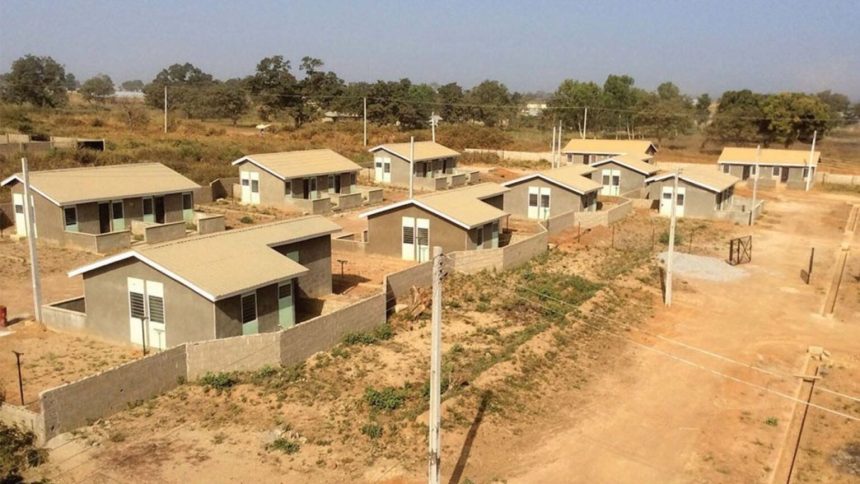
Developers and property experts call for cheaper land, stronger housing supply, affordable mortgages and improved regulation.
Nigeria’s housing affordability crisis is deepening as rising property prices, escalating rents and increasing construction costs place homeownership beyond the reach of millions of households.
Real estate developers, estate surveyors and investment professionals attributed the challenge to expensive land, costly building materials, infrastructure gaps, high financing costs, statutory charges and weak household purchasing power.
The stakeholders made the observations while highlighting the need for reforms across Nigeria’s housing value chain.
Rising Construction Costs Drive Property Prices
President of the Real Estate Developers Association of Nigeria (REDAN), Oba Akintoye Adeoye, said rising residential property prices and rents had become a major concern for developers, tenants, prospective homeowners and investors.
Adeoye explained that housing costs were increasing faster than the purchasing power of many Nigerians.
He said policymakers must examine land acquisition, construction, infrastructure, finance, transportation, professional services and regulatory charges instead of focusing only on the final price of properties.
“When the cost of producing a house increases, it inevitably impacts the price of the finished property,” REDAN said.
However, the association cautioned developers against using rising production costs to justify arbitrary pricing or consumer exploitation.
It called for measures to reduce the cost of land, infrastructure, building materials and housing finance, arguing that lower production costs would enable developers to offer more affordable homes.
Experts Demand Affordable Mortgage Financing
Adeoye urged greater access to long-term mortgage financing, allowing Nigerians to spread homeownership payments over 15, 20 or 30 years.
REDAN also advocated rent-to-own arrangements, cooperative housing schemes and housing savings programmes.
The Ministry of Finance Incorporated Real Estate Investment Fund (MREIF) reported in June 2026 that it had delivered ₦128 billion in mortgages to 1,859 families across 25 states.
The mortgages reportedly carried a fixed interest rate of 9.75 per cent, with repayment periods of up to 20 years and a minimum 10 per cent equity contribution.
By August, the State House said MREIF’s disbursements had increased to ₦140 billion, supporting 2,018 mortgages across 27 states.
Despite these interventions, experts maintained that affordable mortgages alone would not resolve the crisis if housing production remained expensive.
Land Scarcity and Urban Migration
Chief M.I. Okoro, a Fellow of the Nigerian Institution of Estate Surveyors and Valuers (NIESV), identified population growth, urban migration and limited land supply as key drivers of rising property prices.
He pointed to Lagos areas such as Ikoyi, Victoria Island and Lekki Phase One, where developers increasingly construct vertically because of land scarcity and high acquisition costs.
Okoro said rising property values in prime locations were pushing residents towards less expensive communities on the Mainland and outskirts of Lagos.
He called for increased housing supply, social housing programmes and greater involvement by local governments.
“Social housing is not meant to be for profit motive. That is where government comes in,” he said.
Construction Inflation Worsens Affordability
Ayo Ibaru, Chief Investment Officer at housing development company Panterra, described the crisis as the result of interconnected pressures across the housing sector.
He identified rising costs of cement, steel, finishing materials, labour, diesel and imported equipment as major contributors.
According to Ibaru, exchange-rate volatility has also increased the cost of imported materials and technical expertise.
Developers consequently reassess project budgets and may transfer some additional costs to buyers and tenants through higher sale prices, rents and service charges.
However, he noted that developers’ ability to increase prices remains limited by household incomes and effective market demand.
He argued that housing must be affordable to build, finance and maintain.
Land Documentation and Market Transparency
Ibaru also identified inefficient land administration and limited market transparency as factors increasing housing costs.
He called for faster land registration, clearer disclosure requirements for off-plan developments, stronger developer accreditation and appropriate escrow arrangements.
He also advocated better mechanisms for addressing abandoned or poorly constructed projects.
REDAN urged consumers to verify developers and property titles and conduct due diligence before making substantial payments.
Experts Call for Balanced Housing Development
Okoro argued that improving infrastructure and economic opportunities outside major urban centres could reduce migration pressure on cities such as Lagos.
He identified electricity, water, roads and telecommunications as essential investments for smaller cities and rural communities.
The stakeholders agreed that Nigeria’s housing crisis involves multiple factors, including:
- Expensive land and construction materials.
- High financing costs.
- Inadequate infrastructure.
- Weak household purchasing power.
- Limited housing supply.
- Inefficient land administration.
- Gaps in regulation and consumer protection.
The experts said addressing these interconnected challenges would require coordinated action from government, developers, financial institutions, local authorities and other stakeholders.