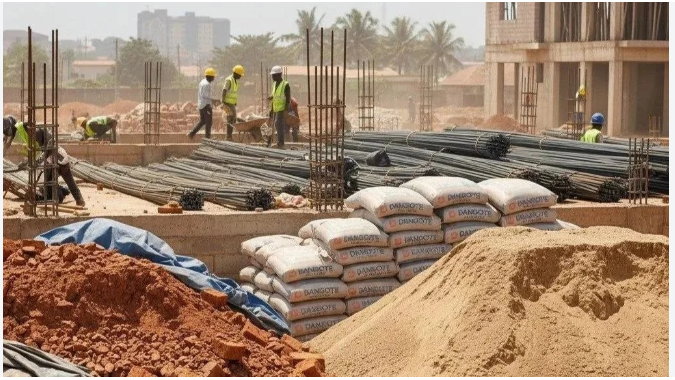
Rising Building Material Costs Put Fresh Pressure on Nigeria’s Real Estate Market
Rising building material costs are putting increasing pressure on the viability of real estate projects in Nigeria, forcing developers to reassess budgets, pricing and construction strategies as the cost of delivering new housing continues to climb.
The rising cost of construction is affecting one of the most important aspects of the property market, the ability of developers to deliver homes at prices that buyers and tenants can afford.
For developers, the pressure goes beyond the price of building materials. Higher input costs are coming alongside expensive financing, land acquisition, labour, energy, transportation and other development expenses, making it increasingly difficult to maintain the financial viability of projects.
Building materials account for a substantial portion of construction expenditure. As a result, significant changes in the prices of cement, steel, roofing materials, fittings, tiles, glass and other inputs can quickly change the economics of a housing project.
When costs increase after a development has already been planned or launched, developers are faced with difficult decisions.
They may have to absorb some of the additional costs, revise specifications, slow down construction, postpone projects or increase selling prices.
Each option carries implications for project profitability, delivery timelines and the ability of the market to absorb the completed properties.
Affordable housing faces greater pressure
The challenge is particularly significant for projects targeting low- and middle-income households.
Developers operating in this segment have limited room to increase prices because affordability is already one of the major constraints affecting effective demand for housing.
Recent industry reports have similarly linked rising prices of cement, steel, sand, wood and other construction inputs to delays, scaling down and, in some cases, suspension of housing projects.
Cement prices have been particularly important to the cost pressures facing developers.
Recent industry data cited by the Real Estate Developers Association of Nigeria showed that the price of a 50kg bag of cement, which was around N7,500 in the final quarter of 2025, increased to between N9,000 and N10,000 early in 2026 and subsequently reached between N11,500 and N15,000 in several parts of the country.
Other construction materials have also recorded increases.
A recent report by Panterra Real Estate Group found that prices of some key structural and finishing materials had risen by hundreds of percentage points from their 2019 levels, with iron rods and other materials among those experiencing substantial increases.
Developers reassess project viability
The effect of rising material prices is not limited to individual construction inputs.
Developers must account for the combined impact of materials, land, finance, labour, infrastructure and logistics when determining whether a project can be completed profitably.
Industry stakeholders have said this is making it more difficult to predict the final cost of developments, particularly for projects with long construction periods.
A project that appears financially viable at the planning stage can become more expensive to complete if the prices of major inputs rise significantly during construction.
This creates additional uncertainty for developers, particularly when properties have already been marketed or sold at prices based on earlier cost estimates.
Developers may therefore have to review their construction specifications, procurement strategies and project timelines to manage the impact of changing prices.
Impact on homebuyers and tenants
The pressure on developers can eventually affect consumers.
Where developers are unable to absorb higher construction costs, some of the additional expenses may be reflected in the prices of newly completed properties.
This can make homeownership more difficult for households that are already struggling with limited incomes and high financing costs.
The rental market can also be affected because landlords and property investors may seek to recover higher development and maintenance costs through rents.
Recent reporting has linked rising development costs in major Nigerian cities to increases in residential rents, particularly in Lagos and Abuja.
For prospective homeowners, the combination of higher property prices and expensive mortgage financing can further widen the gap between household incomes and the cost of purchasing a home.
Housing supply could also be affected
Another concern is the potential effect of rising construction costs on the volume of housing delivered to the market.
If developers postpone projects or reduce the scale of planned developments because of rising costs, fewer new homes may enter the market.
This is particularly significant for Nigeria, where demand for housing continues to grow as the population expands and more people move into urban centres.
The pressure on supply could become more pronounced if affordable housing projects are disproportionately affected because such projects generally operate within tighter price and profit margins.
Industry stakeholders have therefore continued to call for measures capable of stabilising the building materials market and supporting housing delivery.
Imported materials add to the pressure
The cost of building materials is also influenced by Nigeria’s exposure to imported construction products.
A Panterra report noted that between 60 and 80 per cent of some finishing materials, including tiles, sanitary ware and window fittings, are imported. It linked the price increases to factors including currency depreciation, import exposure and rising production costs.
Changes in foreign exchange conditions can therefore affect the cost of materials and components that developers depend on.
For developers, this can make budgeting more difficult and increase the risk of cost overruns, especially on projects that require imported finishing materials.
Industry calls for intervention
The Real Estate Developers Association of Nigeria has called for greater engagement between government and stakeholders across the building materials value chain to address price instability.
REDAN President, Oba Akintoye Adeoye, has warned that the combined effect of rising construction costs is putting financial pressure on developers and contributing to project delays, scaling down and suspension.
The association has also raised concerns that persistent cost increases could make homeownership more difficult for Nigerians and potentially encourage the use of substandard materials by individuals seeking to reduce construction expenses.
Recent industry reports have similarly called attention to the need for greater local production and measures that can reduce dependence on imported construction inputs.
Real estate sector faces a difficult balance
Nigeria’s real estate sector is therefore facing a difficult balance between rising development costs and the need to keep homes within the reach of buyers and tenants.
Developers must continue to manage land, financing, labour, materials, infrastructure and logistics while responding to changing purchasing power.
For the wider housing market, the challenge extends beyond developers.
Higher construction costs can affect housing supply, property prices, rents, mortgage affordability and the pace at which new developments are delivered.
As Nigeria continues to require more housing, the stability and affordability of construction inputs will remain an important factor in determining how quickly developers can bring new homes to the market.